Music Mosaic of Southern Indigenous People

This week in music class, we toured the music of the nearest indigenous peoples to Antarctica. I created a tour for the students to explore the music of the Māori, Palawa, Noongar, Xhosa, Khoekhoe, Selk’nam, and Yaghan people. We reviewed the information related to Pangea, so that students could see that Antarctica used to be attached to other countries and continents.

In addition to listening to traditional music of these cultures, we learned facts about the people and looked at some of their artwork and symbols. The students were fascinated!

I had the students write one measure of music to reflect the style of music they enjoyed the best on the tour. They then decorated their music with the symbols and artwork of their chosen culture. I originally thought the students would use the 5 lines for composing their measure of music, but so many of the students really enjoyed the music of many cultures and turned their five lines into music from their 5 favorite cultures!
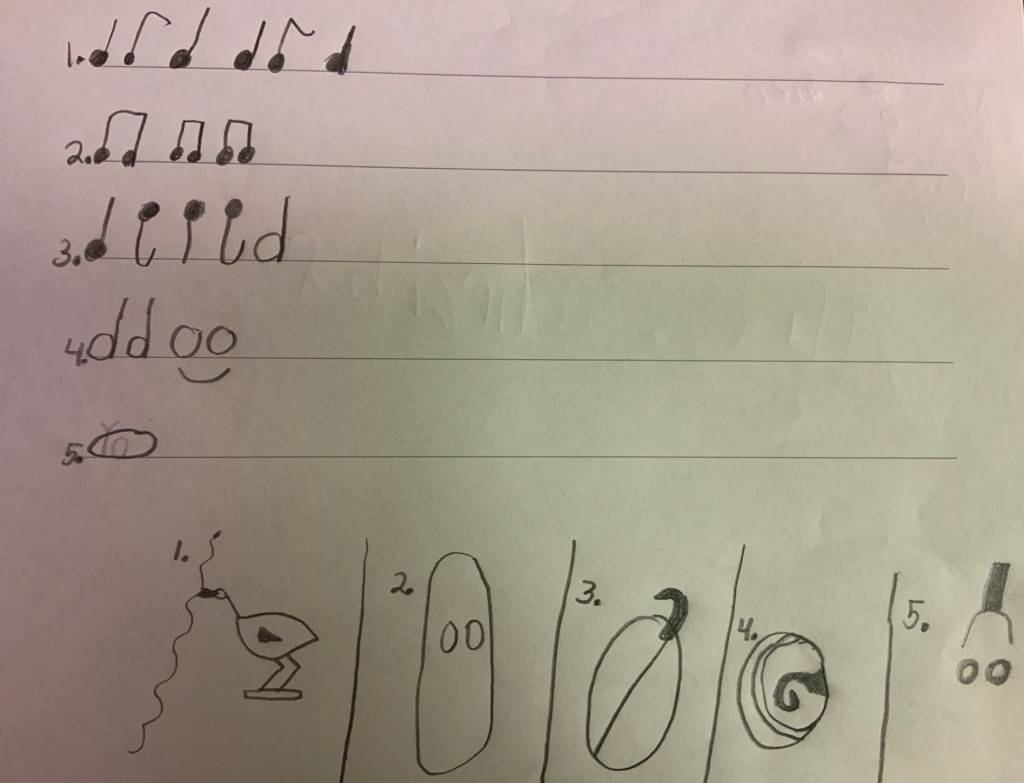
I had originally wanted students to pick the ONE tribe they liked the best, but I was surprised by how many students liked SO many of the recordings! I allowed them to create music and art for each tribe they connected with!

After the compositions were complete, I hung them all up in the hallway creating an artistic mosaic of the cultures we toured.
Antarctic Beatboxing!

Today was an interesting day, as we had the local news channel come in to observe how the students and I were making use of the Antarctic expedition. They had been in before I left, and were now doing a follow-up, which was great to be able to feature the students!

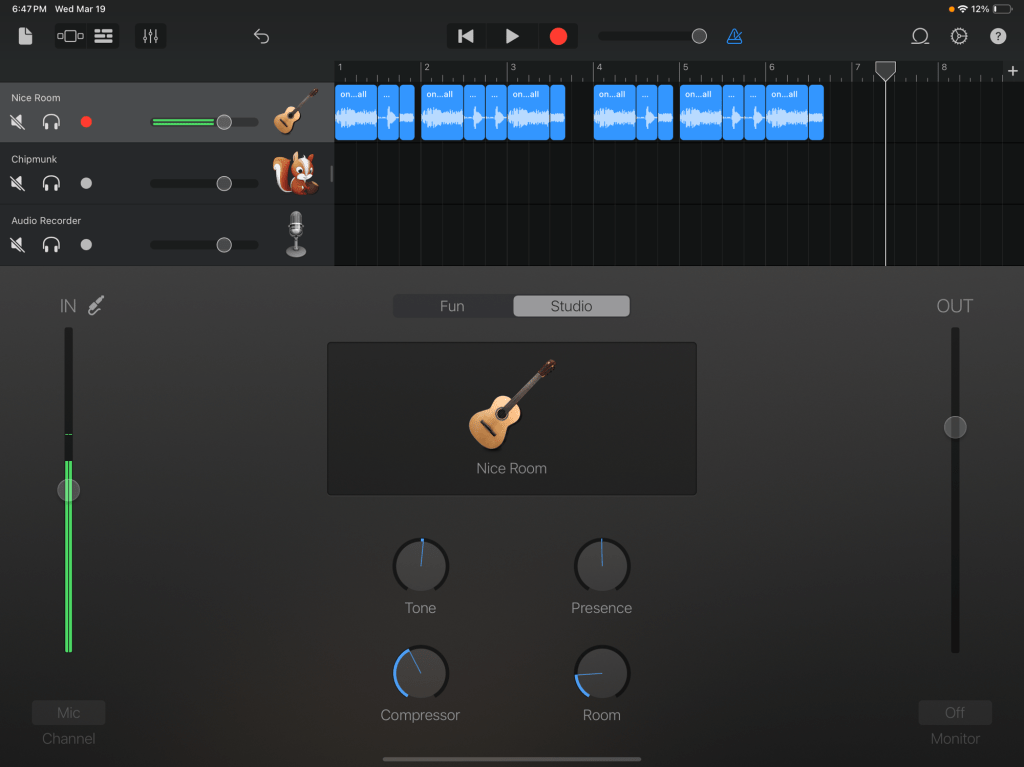
For today’s lesson, the students were going to take full-length recordings I had made on my expedition, trim them to isolate one sound and then create a beatbox-type composition from a collection of isolated sounds. Older students did this using an online-based platform found at audiomass.co, and worked individually. Younger students participated in this by composing the groove as a full class – each student picking out which sound they want to add next. I pre-isolated those sounds for them, and then we slid them in place using my iPad with GarageBand. This allowed us to drag and drop the sounds into our timeline until every student had gotten to pick out a song.

We talked a lot about repetition, and watched Pentatonix for a sample of real beatboxing in action. We also watched a video on YouTube called “Animal Beatbox,” where a collection of animal names are repeated to solidify the groove.

Students had a lot of fun with this, and surprisingly, the youngest students were actually the best at making the grooves, as they enjoyed the repetition of picking the same sound as their friend did earlier!

This is the 3K/4K beatbox. We then looped it while they danced to the groove!

Music in the Shape of Antarctica

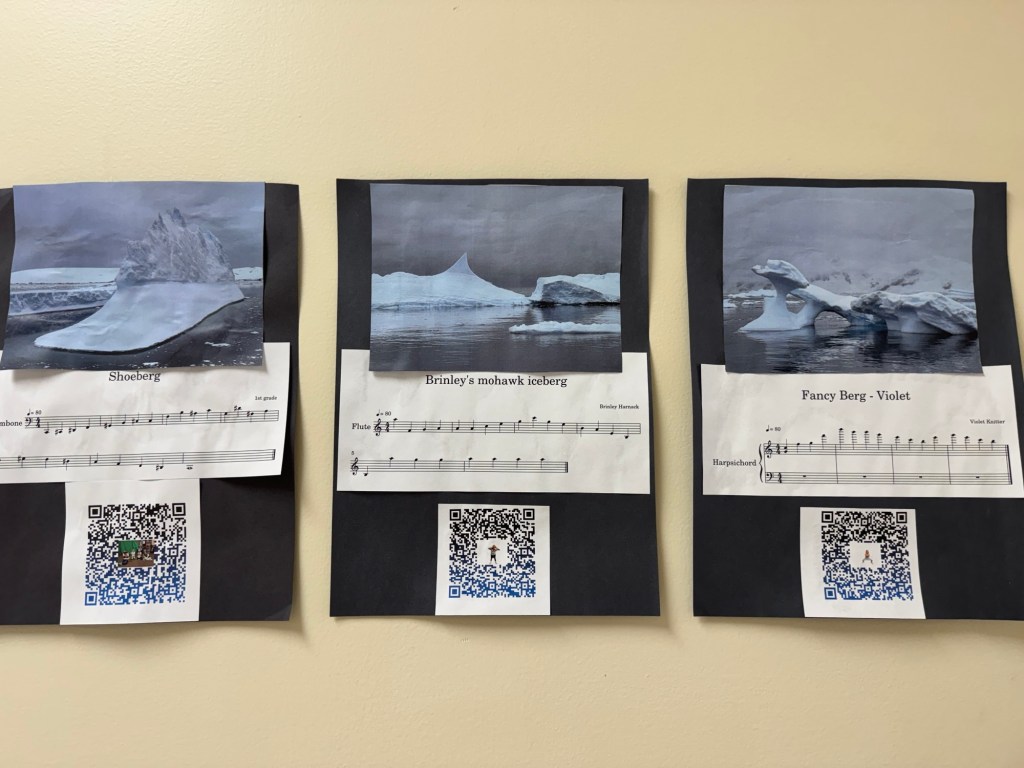
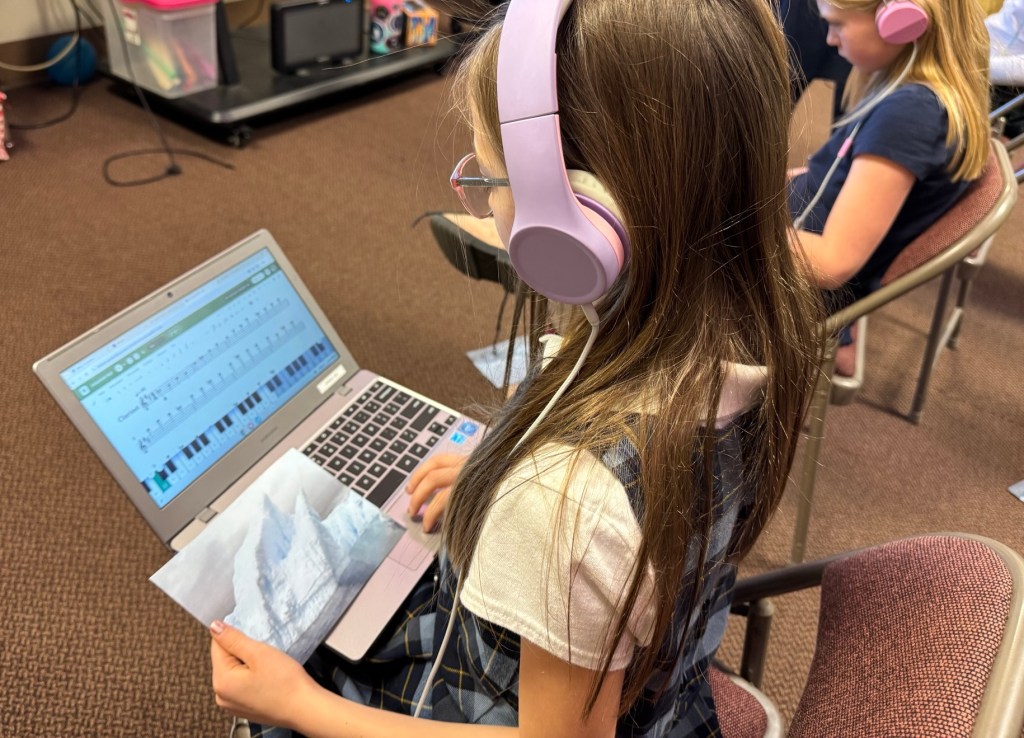
Our younger students are learning about high and low notes and the shape of music. To practice this, I let each student in grades PreK-4th grade pick out an iceberg photo that I took on my expedition. They then had to create music in the shape of the iceberg – the music needed to go up when the shape of the berg went up, and down when the iceberg sloped downward. We then hung up our work in the hallway, with QR codes so that people can listen to them.

Composing music to match the shape of the iceberg
Sample artwork hung in our hallway!

Antarctic Word Cloud

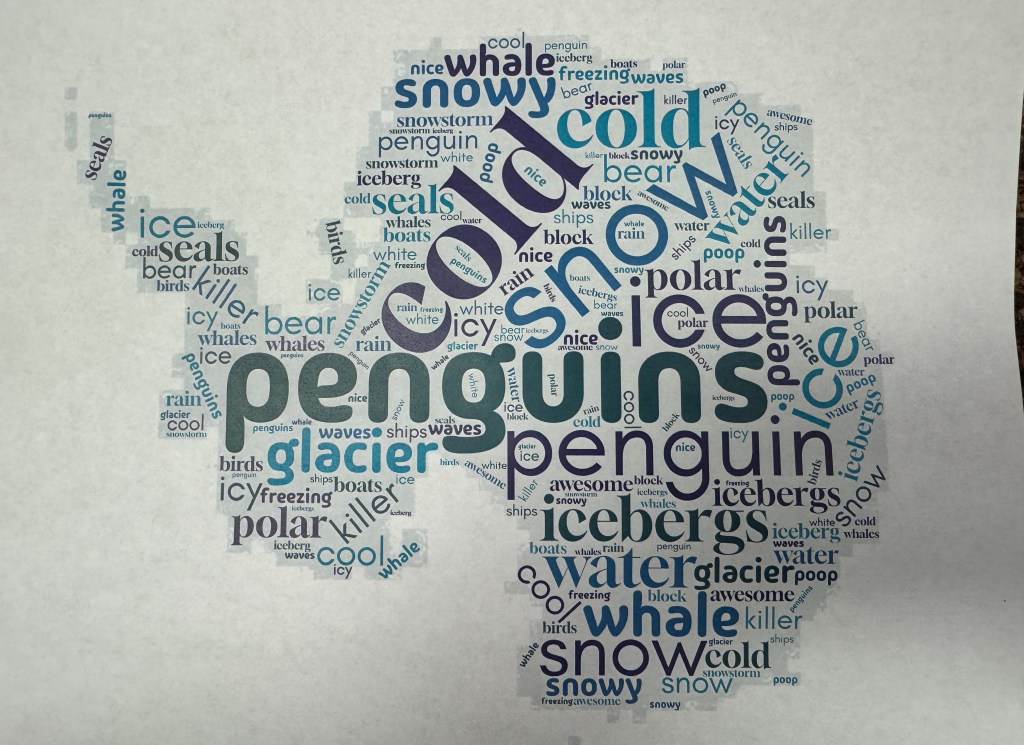
I’ve had students write words down after each lesson to see what lasting effects Antarctica is having on them. I created this word cloud to show how they’re doing. You’ll have to excuse the word ‘bear’ that shows up, as the students were talking about whether they could bear the isolation….they do know there aren’t polar bears in the Antarctic! I’m hoping to see how this word cloud changes as we continue our learning throughout the rest of the year!

Fulbright Teachers for Global Classrooms Symposium

I am so excited to share that I was accepted into the Fulbright Teachers for Global Classrooms program – I found out in August of 2024 (while I was out in Boston accepting an award). Last winter/spring, I applied for NOAA Teacher at Sea, the National Geographic/Lindblad Expeditions Grosvenor Teacher Fellowship, and the Fulbright Teachers for Global Classrooms (TGC) program. I thought if I was lucky, I would get one of them. Imagine my surprise when I got all 3! I am so grateful that I have an incredibly supportive principal, who instead of grimacing about the idea of her music teacher being gone during the school year for THREE programs, she was excited and congratulatory.

The Fulbright program is the final of those programs that I am so grateful to get to participate in this year. I found out in December that I will be traveling to Senegal in April! I was very excited, as I have never been to the African continent, and I know very little about Senegal. I also know that this will be incredible for the students I teach, as there are so many misconceptions about life in Africa – it has been a source of great frustration on the middle school social studies teacher (my friend and colleague) as she has noticed most of the students in our school think of Africa as a country, and make assumptions about the entire continent that just are not accurate.

The first part of this program involved a 10-week online course. Luckily, it started the week I got back from NOAA Teacher at Sea, and ended the week I came back from Antarctica (with a week off for Thanksgiving, which helped me stay on track while I was not able to do work while in the middle of the Drake Passage!). The course was very eye-opening, as I thought I was pretty good at global education. After taking this course, I learned so much more and feel set up to really take my teaching to an entirely new level. I am so excited to continue the work I did in that course as I plan more experiences for the students at my school.

Lessons like these were what we developed during our class. We also were required to partner with a classroom in a different part of the country, which the students of my school LOVED. They had the opportunity to write video game music for students in Kentucky who made their own video games! I used 1st-3rd graders since the teacher I was partnered with had 2nd and 3rd graders.

The next phase of the Fulbright TGC program is a Global Education Symposium in Washington, DC. I got to go in February, and my principal got to travel with me as part of this program. What a great treat to be able to travel with the woman who has been writing me these incredible letters of recommendation to get to participate in these amazing programs that have brought such wonderful learning lessons to the students of our school!

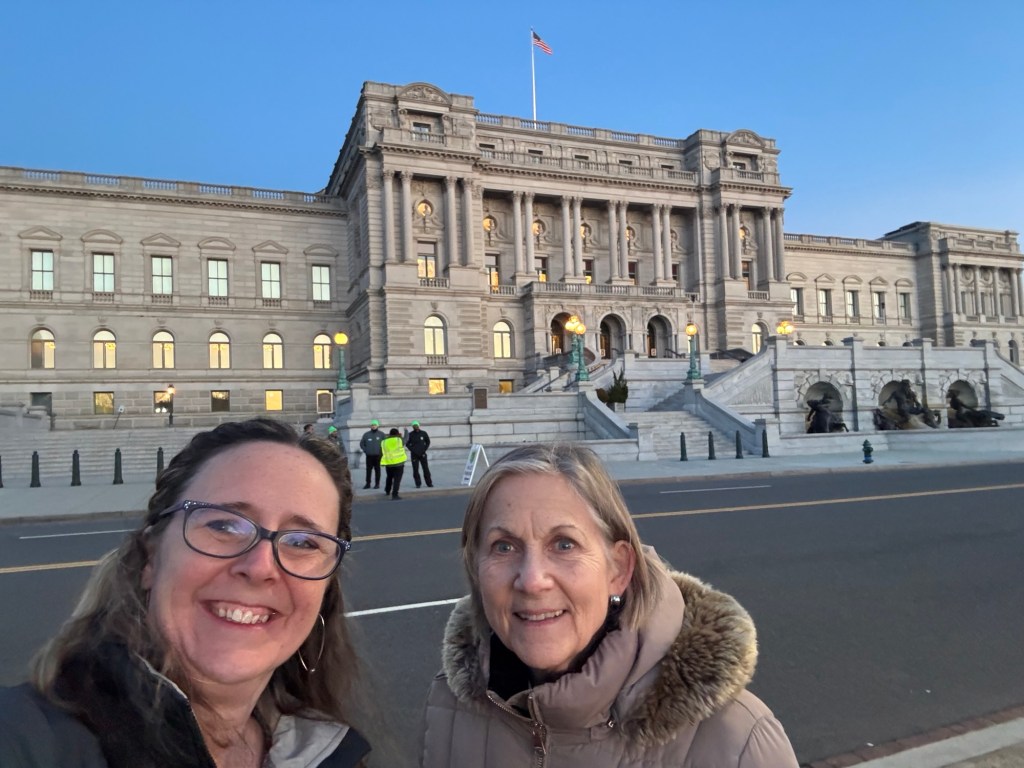
My principal and I outside the Library of Congress, where we were unsuccessful at acquiring library cards.

My principal and I wanted to travel together (apparently not all of the administrator/teacher duos did, and some administrators didn’t even come!). We arrived late morning on the first day, and navigated our way to the hotel using the metro. Then we walked to the National Museum of African American History & Culture, which is one of the newer Smithsonian museums in Washington, DC. We met a wonderful man who was working at the front desk, and he guided us in how to start our adventure in this incredible museum. I was excited to go to this museum, as I thought it would be the perfect way to ready for Senegal. Senegal actually was one of the deportation sites of slaves bound for America. I learned so much in this museum – a docent in the museum taught us that EVERY country/culture in the world has had slaves at some point. Even neighboring tribes would collect slaves from the tribes that they feuded with. I also learned that countries such as France and the UK sent slaves to America. It was an incredible museum that moved me just as much as the Holocaust Museum did a few years back.

‘Playing’ Charlie Parker’s saxophone at the National Museum of African American History & Culture

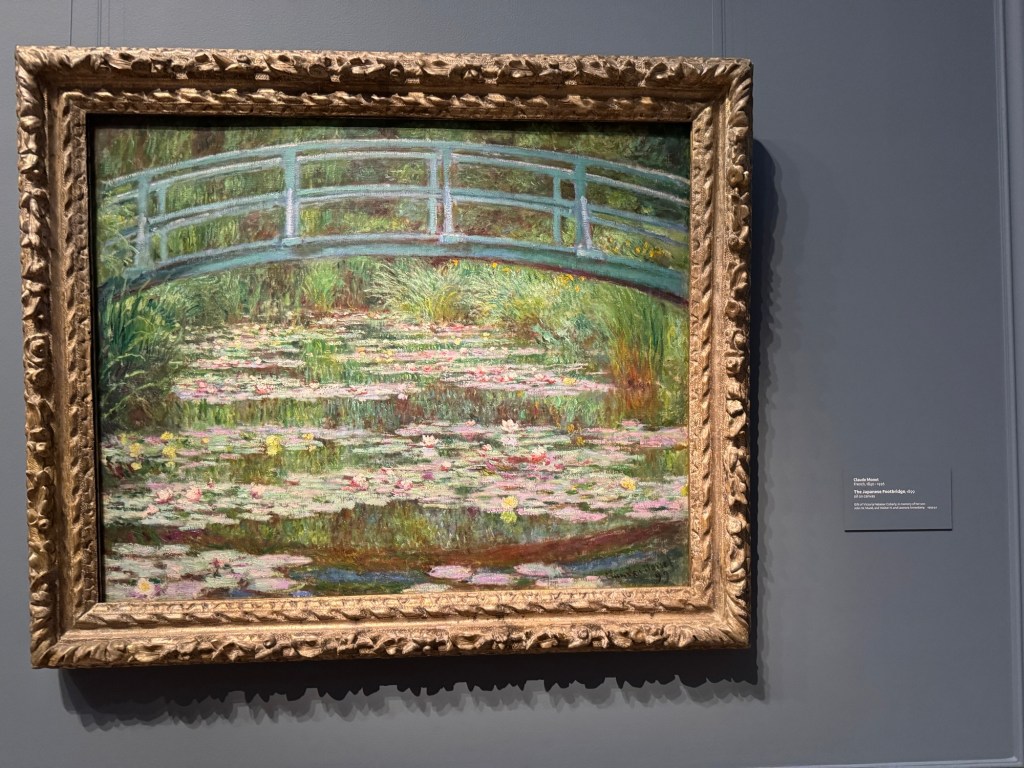
We also booked it on over to the National Gallery of Art. Unfortunately, we spent so many hours in the African American museum that we didn’t have much time to visit the National Gallery. However, we managed to find the Impressionists, which I was excited about. I had also never been to the National Gallery, so that was great.

Monet!

By that time, it was time to come back to the hotel to start our symposium with the welcome session.

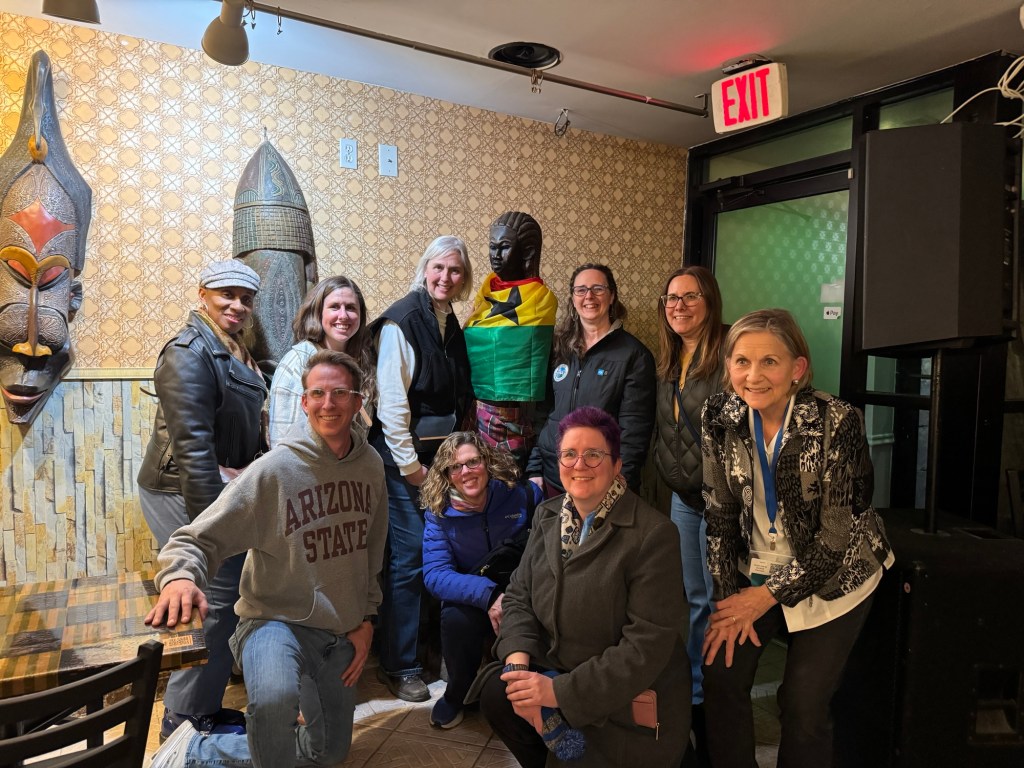
Some of my fellow Senegal cohort!

The symposium was great – we got to learn so much more about what our field experience would be like. The best part about it was that they divided us into our travel cohorts by country that we will be going to for our field work. It allowed us to get to know the people we would be traveling with from the very first moment of the symposium. We all clicked right away – meeting up and sitting together for all of our meetings, planning our dinners together, and making plans for our travels. We have been collaborating ever since, and sharing every little bit of information we hear. It is so nice to have such a wonderful group of teachers to share this experience with.

Pardon the inaccurate pointing…the globe kept rolling away! 😂

We learned about the country we would be traveling to, and about the expectations for our culminating project. We got to meet members of the US State Department, the International Research & Exchanges Board (IREX), and the Fulbright program organizers. We shared our global education lessons with each other in a gallery walk, which gave me so many ideas for my classroom, and let me get to know the people in my cohort even better! We also got to go to a Global Education Resource Fair, where we met with vendors of curriculum, research organizations, and companies that have resources, materials, opportunities, and experiences to help teachers with global education in their classrooms. It was really fun to find new organizations willing to help build music into global curricula! My fellow Senegal travelers, my principal, and I all went to a West African restaurant to get a taste of what we were going to experience when we go on our field experience.

Yummy food!
Dinner to experience Senegalese food…none of us had any trouble enjoying our orders!

To say that I left inspired feels like it is an understatement. I learned so much in the 10-week course, but I was most excited after leaving this symposium. So many great people have now joined my teaching and collaborating network. I’m traveling with a bunch of teachers who all have been musicians or are incredibly supportive of music education. I made fast friends with STEM teachers in my cohort, obviously. I now also have English and ESL teacher friends from around the country. It feels so good to continue to grow my network of teachers across the world!

Ready to take on the world?!? We’ll see

Next up…..planning for a trip to Senegal in person! Time to get the students excited and curious!

So grateful to this woman for being my mentor, letter of recommendation writer, and greatest cheerleader!

Antarctic vs Wisconsin Weather Temperature Compositions

While I was out of town for my Fulbright Global Symposium, the students got to take the data they had collected on the weather in Wisconsin and combine it with the observations I had made while in Antarctica.

This idea came from the craft concept of Temperature blankets, where people will crochet or knit a row onto a blanket representing the high temperature of the day for a full year. By the end of the year, they have a 365-row blanket that depicts the temperatures in their location throughout that entire year. They are very unique, and often quite beautiful!

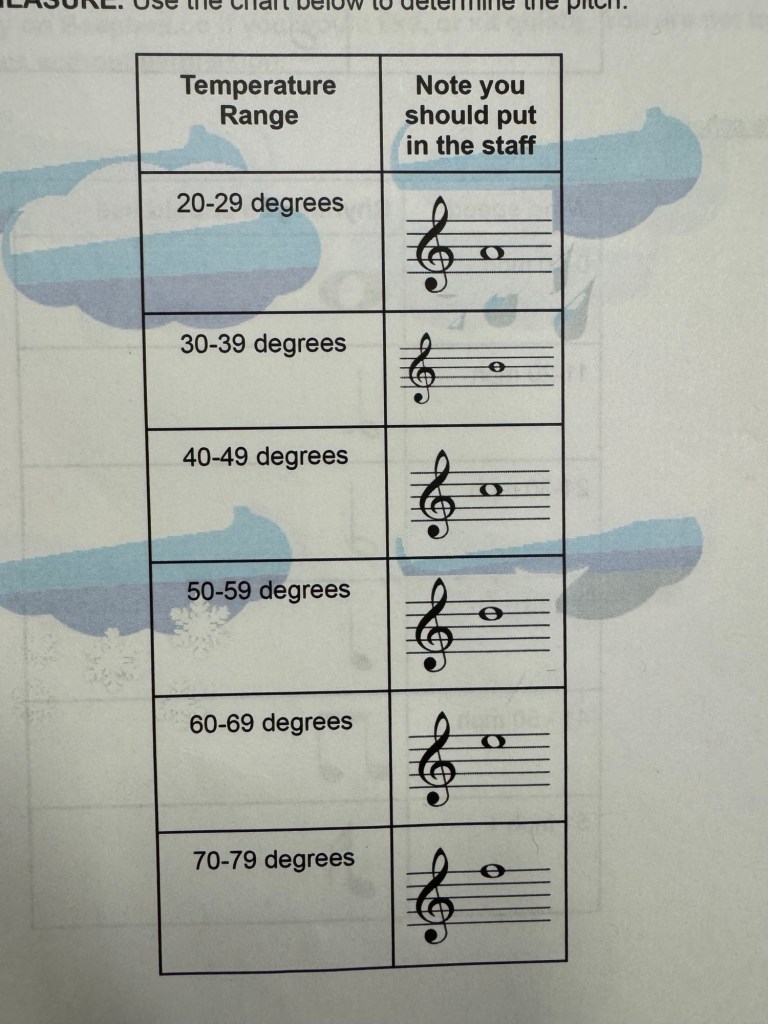
I created a chart for students to be able to compare their temperatures to in order to assign the correct notes and rhythms for the weather they had. They were also required to pick out an instrument that represents our state, school, or the student personally.

Note choices….
Rhythm guide

I then shared my data with them and they had to plot this onto a duet part to accompany their weather melody. They had to pick out an instrument that represented Antarctica.

When I talked to the students about how the lesson went, they were surprised by the number of times that they were cooler in Wisconsin than I was in Antarctica. They also were impressed by the wind speeds I experienced.

The weather musical composition wasn’t always pretty sounding, either, as we were often similar enough in temperature that musical dissonance occurred. We talked about why that dissonance happened, and now they realized that dissonance can be a useful compositional technique, as we explored why a composer would choose to put dissonance into his/her compositions.

Water Instrument Design Challenge

Our next great water/music adventure involved students learning about instruments that music use of water to create their sound. We studied things like Benjamin Franklin’s armónica, crystal glasses filled with water, Chinese water bowls, the Zadar Sea Organ (in Croatia), the water gong, Benin Water Gourds, Norwegian Ice Instruments, and watched the STOMP video where they are standing in water raising and lowering pipes to bend the pitch. We watched a physics demonstration about the resonance of a glass tube, and how the quantity of water really matters when trying to get the best sound. We discussed how there are really four different ways to make sound in instruments – blowing, shaking, striking, and scraping.

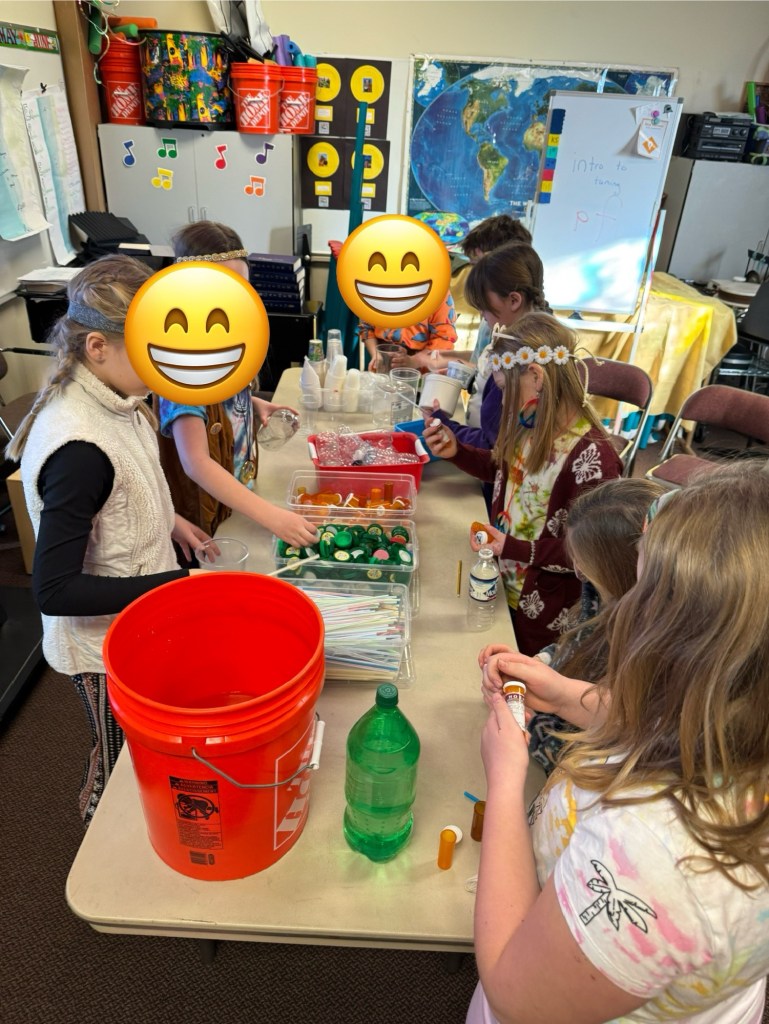
Now came the fun part – students (preK-8th grade) were given the opportunity to take on an instrument design challenge where they had to create a new instrument that used water. I made them another wonderful Antarctic saltwater blend, as I knew some of them would wonder if their instruments sounded different with saltwater vs. freshwater (they have gotten very good with curiosity and experimentation, and I encourage such behavior in class!!!)

Design challenge underway!

It was really fun for students to create, test, modify, recreate….and then they got the opportunity to perform on their instruments for the classmates. They loved performing with the VR headsets again, as I gave them the option to perform on the water or ice of Antarctica again.

Ocean Waves and Sound Waves!

The next adventure the students and I embarked on was an up-close study of sound waves. Anyone who knows me, knows this is my passion! I have loved sound waves and all of the nitty-gritty physics of sound waves ever since my dad took me into his work when I was younger and showed me an oscilloscope. Then, in high school, I did my entire final physics project on the physics of music (this may have been a ploy to get to play with my dad’s oscilloscope again). Fast forward to my masters program where my final project was on tuning of all band instruments and how that relates to the physics of what’s going on with the ‘waves’ you hear when you are out of tune (another excuse to play with the oscilloscope!).

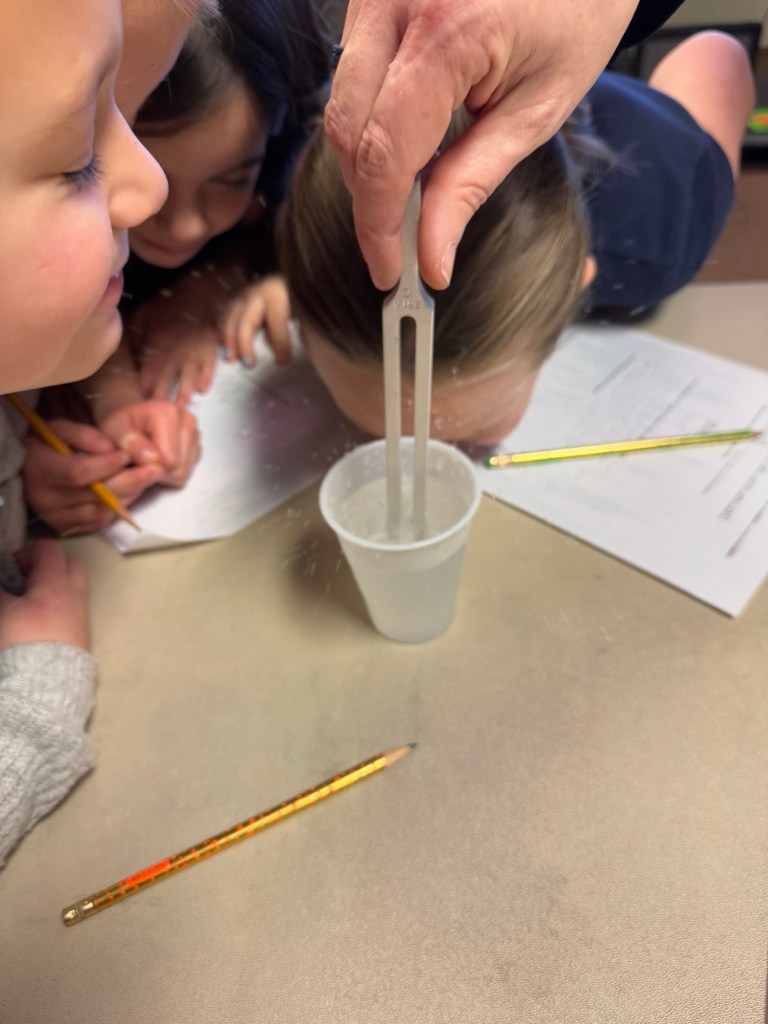
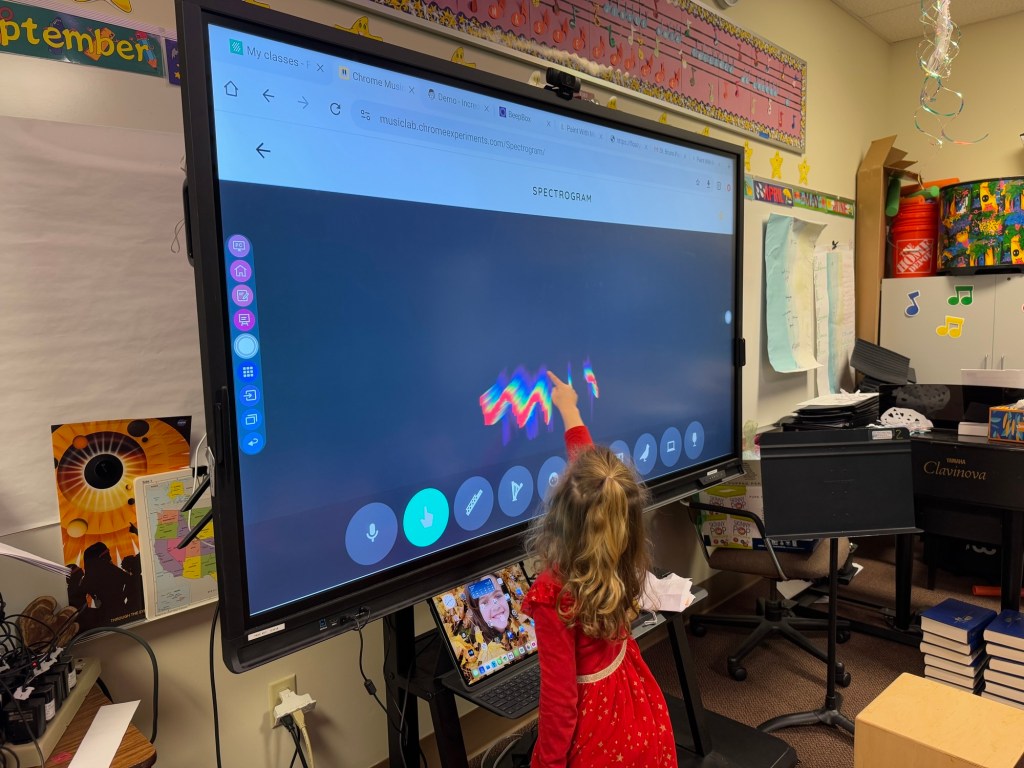
The students got to see sprinkles dance on a cup covered with plastic wrap, feel vibrations on crash cymbals, see vibrations when a violin string is plucked, experiment with putting tuning forks in water, checking out Kundt’s tubes when instruments play into them, discovering the beautiful artwork created by sound on chladni plates, and look at their voices on an oscilloscope.

Feel the sound!
Getting close to the tuning fork water explosion!
Chladni design!

We then compared what we could see about sound waves with what we knew about ocean waves. I showed the students videos of the Drake Passage crossing we did, and students enjoyed imagining themselves on a ship in those waves.

Water Color Painting with Antarctic Water (Kind of)

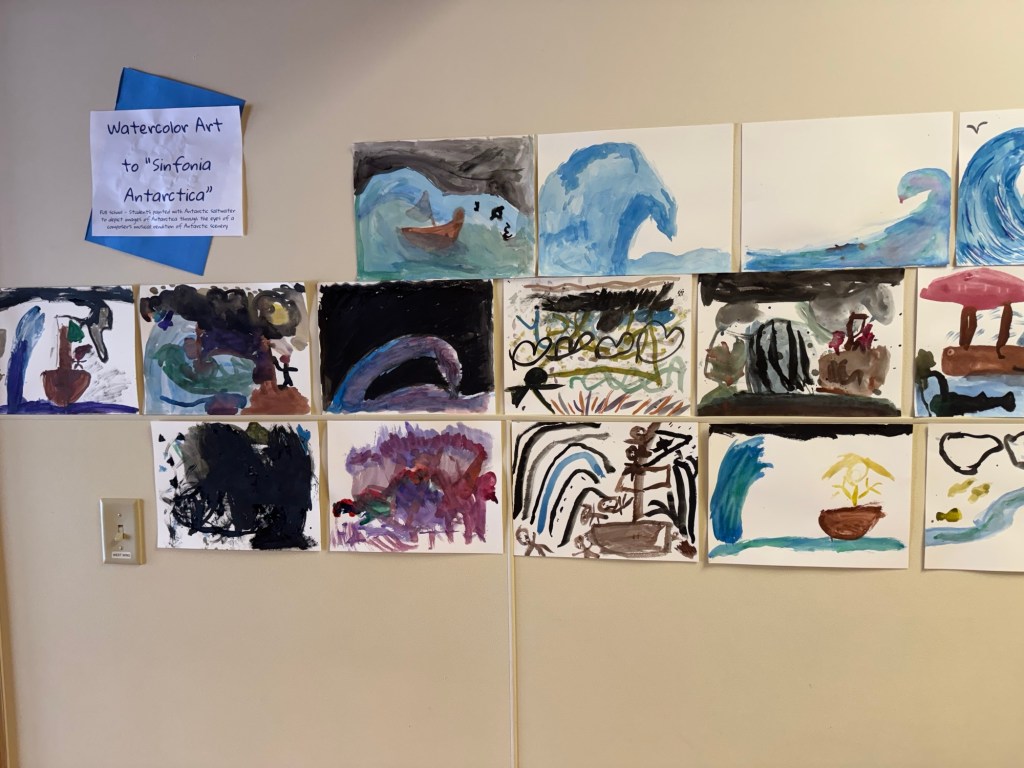
Our next project was another fun one. Students of all ages had the opportunity to paint to music. We listened to Ralph Vaughn Williams’s “Sinfonia Antarctica,” which he composed for a film on Robert Falcon Scott’s disastrous expedition. I did not tell the students what the music was written for at first, as I wanted them to decide what they thought Vaughn Williams was trying to tell us about his music.

While I was in Antarctica, I had the opportunity to kayak in the Weddell Sea. When I was out kayaking, I took out my Vernier water sensors, and tested the Weddell Sea. One of the measurements I took was the salinity (or saltiness) of the water. With that data, I was able to make my own saltwater that matched the salinity of the water I was in for the students to use when they did some watercolor painting to “Sinfonia Antarctica.”

Students listened to Ralph Vaughn Williams’s piece, and created a painting to match what they heard through his music. Before we listened to the recording, we looked at famous artwork that was influenced by the water – such as Claude Monet’s “Impression: Sunrise,” Katsushika Hokusai’s “The Great Wave Off Kanagawa,” and Georgia O’Keefe’s “Blue Wave Maine,” among others. Students were then inspired to make their own art while listening to “Sinfonia Antarctica.” I was impressed by how many students heard moments that made them think of giant waves, shipwrecks, and other dark moments on that water.

Samples of student work!

It was a lot of fun, and I enjoyed collaborating with our school’s fantastic art teacher in planning the painting portion of the lesson! I hung up every student’s artwork in our hallway so that everyone visiting our school can see the work our students did!

Sea Chanteys in Antarctica!

Welcome to 2025! Now that our Christmas concert is in the books, and Christmas break has come and gone, it’s time to get rolling on some of our Antarctic work in the classroom! After our concert was over, we did our explorer photos in my orange parka, and I’ve got pictures of the students in the landscape pictures I took while on my expedition. Now it’s time to dig into the serious work!

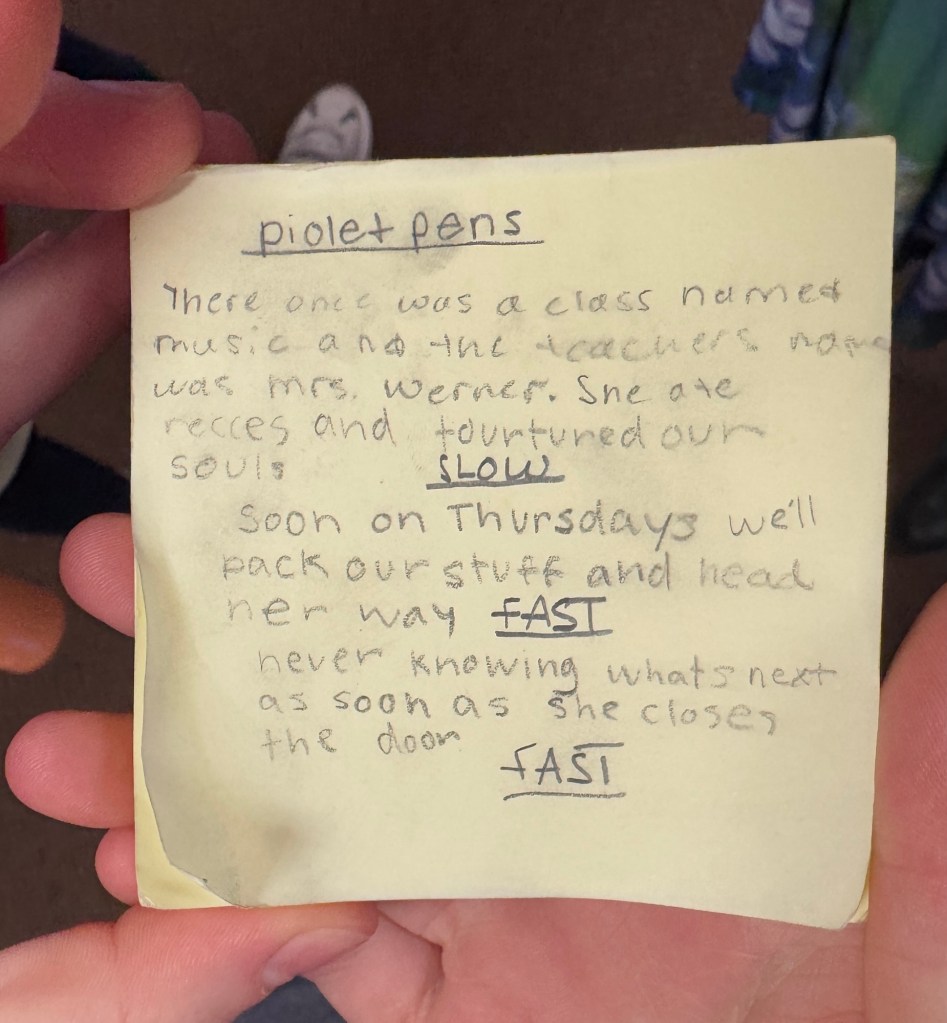
The first project we’ve worked on is the study of sea chanteys. Our spring concert is going to be water-themed, and this is the start of the journey. I introduced students to #ShantyTok on TikTok, and we watched a few epic performances. The students then went on a tour of sea chanteys from around the world. We even watched a short clip from “Big Bang Theory,” where Sheldon and Penny were using a sea chantey to complete a task. Students then deduced the purpose of sea chanteys.

These girls cracked me up by writing a sea chantey about my music class! We all laughed about their lyrics!

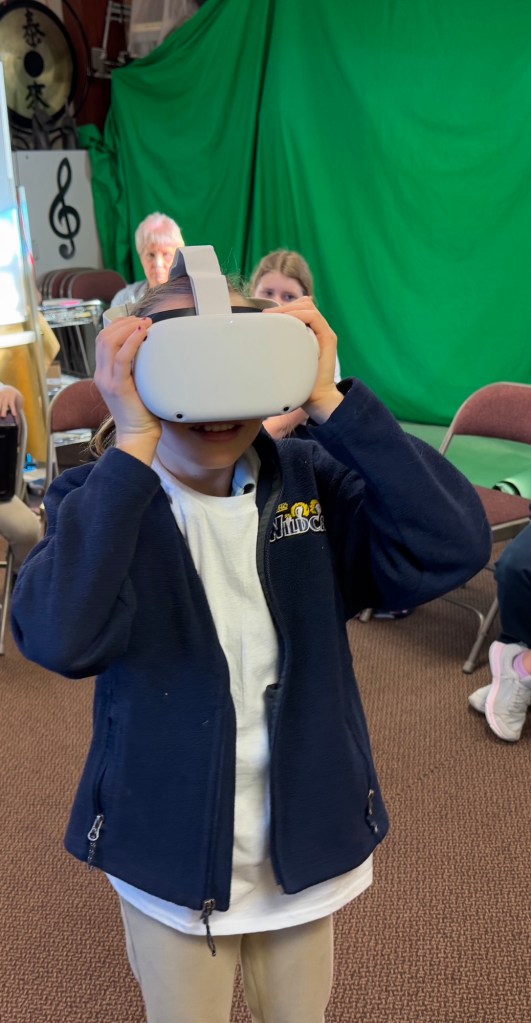
Once we figured out the purpose of the sea chantey, students got into groups to create their own sea chantey. They had to write it about an activity that is not enjoyable, goes on too long, or something they have to do often. Once they got done, they performed their sea chantey for the class while wearing VR headsets. I had recorded several 360-degree videos on my expedition, so students were able to perform their sea chanteys ‘at sea in Antarctica.’ Due to most of the students not having experience with VR, I did not have them perform while watching Drake Passage crossing footage!

Sea Chantey performed ‘in Antarctica’!

The littlest students worked as a full class to write ONE sea chantey, and then got to create their own composition using Google Arts Paint With Music (Ocean setting).

The students really enjoyed the unit (more than I thought), and I don’t think it was all because of the virtual reality – they really got into sea chanteys!