Young Musicians Are Changemakers!

The culminating project in this entire Antarctic water and music themed semester is something the students I teach got REALLY excited about. I wasn’t sure how they would react – I feared groans and eye rolls, complaining and apathy. Instead I got students choosing to work outside of music class (despite my telling the students they would have class time to work) and a buzz throughout school that came back to me in discussions with my colleagues and the parents of the students!

I wanted students to combine the knowledge we gained through studying how music can help create change (both through sonification of scientific data and by studying celebrity musicians who have used music as a platform to create change and raise awareness).

To synthesize their learning, students created their own music, websites, and projects centered around causes they care deeply about – each one connected to the theme of water to match our water theme for the year. Whether it’s access to clean water, reducing pollution, or protecting aquatic life, their causes were chosen because they felt a personal connection and a desire to help. I gave the students the opportunity to choose their own community service project to design, encouraging them to think creatively to solve the problems they connected with.

We were guided by the United Nations Sustainable Development Goals and the Catholic Works of Mercy, helping students think both globally and spiritually about what it means to care for our world and for one another.

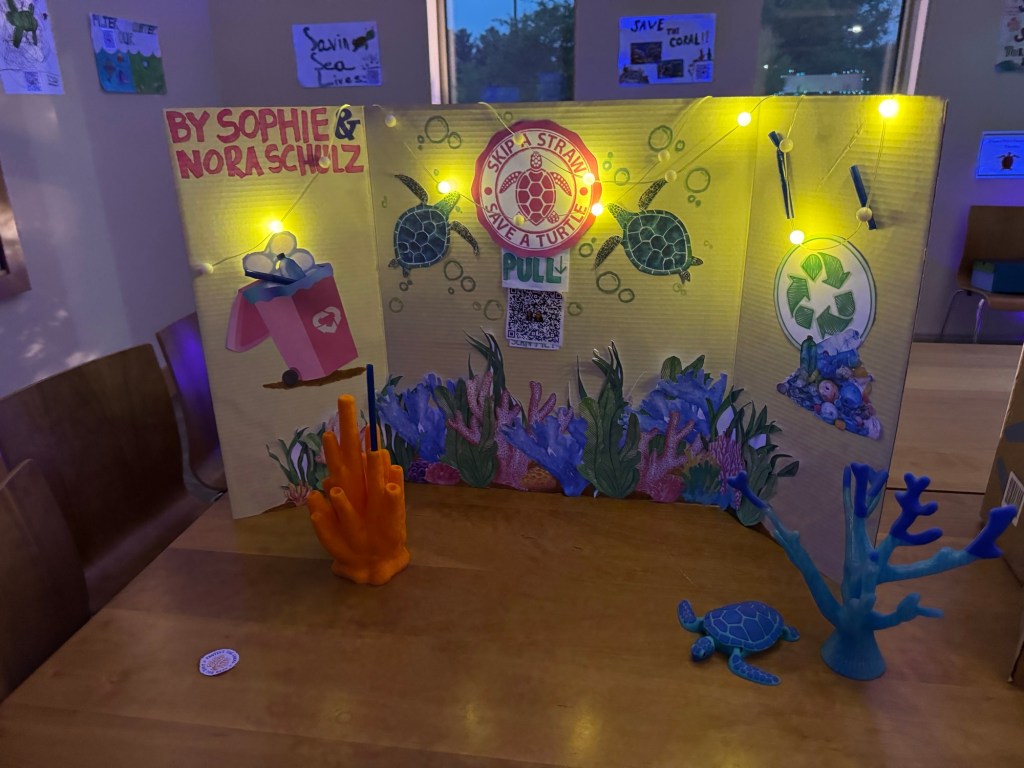
We then created a “Dreams Room,” set up in a room located in our church and setup for viewing during our all-school spring concert. Audience members were able to walk through and see our students’ hopes and dreams for a better world displayed—and ways our audience could help bring those dreams to life. Some students suggested supporting organizations through donations, while others encouraged simple but powerful actions like changing habits at home, or joining a local cleanup. Audience members scanned the QR code on each poster or display to visit the students’ website. From there, they found the students’ research, why the students felt that was an important problem to help solve, what they asked people to do to help, and hear their songs. 
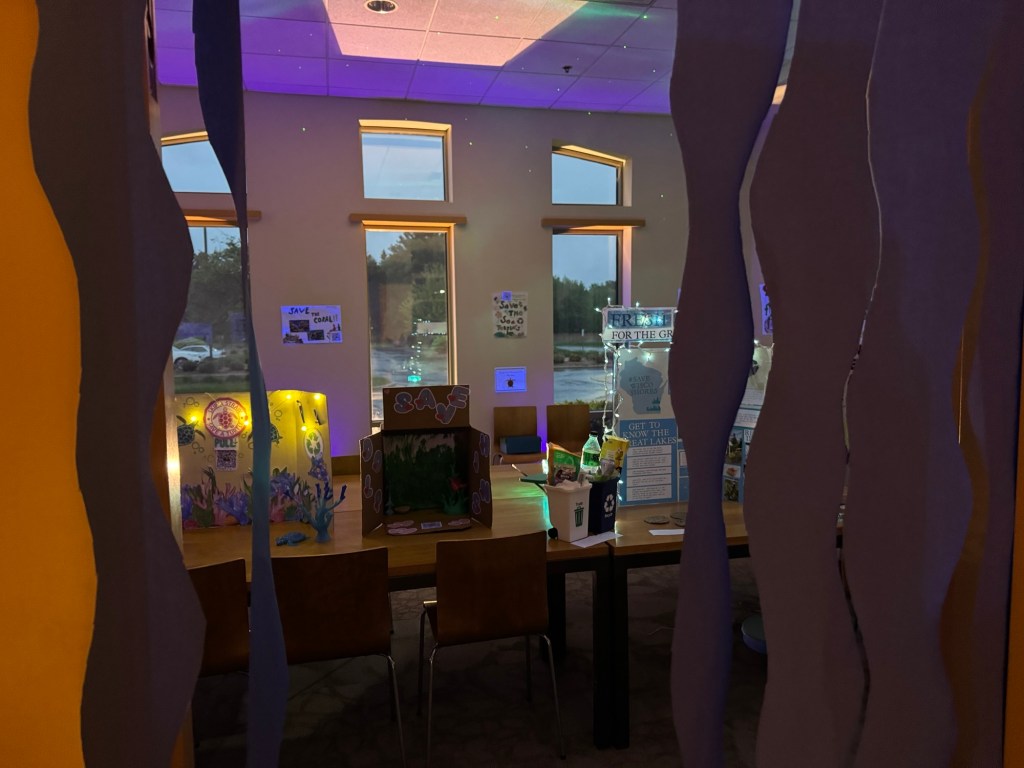
Entering the Dreams Room through the Ocean Wave entrance!
Most students did posters to display their QR codes, so we made sure to make use of our mood lighting to make the room even more fun!

This experience was a big hit – the room was packed after our spring concert. Some students even went above and beyond – creating bracelets or coasters from recycled materials to sell in order to raise additional money for their organization, while also helping solve the trash in our waterways problems. One group made brownie bites and sold those for additional money towards their organization. Another group formed a Bark River Cleanup club and set monthly meetings. They will alternate buying pizza for all who come to the meetings.

Coasters and 3D printed recycling bins bring this local waterway project to life
I learned so much from this project – it was fun to have the students be the teachers
Another beautiful display from our students!

After surveying the students at the conclusion of the project’s display period, students loved this project. Students talked about how exciting it was to find something they cared about to work towards. Many of them mentioned how they were really skeptical about how they could possibly make a difference in the world through a music class project, but were so excited to see how much impact they had. Every single student said they couldn’t wait to take action on an issue they found important again. I really don’t know who is more inspired by this project – the students, the adults who visited the Dreams Room, or me! I can’t wait to modify this and try a variation of it next year!
Traveling to Senegal? Here’s what you should know!

Found yourself going to Senegal for a Fulbright program? Maybe you are looking for a new adventure and are going to become a tourist to Senegal. Either way, here are the things I packed and wanted to know that will help others as they prepare for a trip to Senegal.

Packing list: 1) Grayl water bottle – I brought this, but we purchased bottled water before we left Dakar in enough of a quantity that I didn’t need this. It was nice to know that I had it in case I used up my water, though. Piece of mind is everything when dealing with water you cannot drink coming out of the sink!

2) Insect repellant – I brought hefty spray with DEET. My travel companions had DEET wipes – these were the best!

3) Pepcid chewables – a friend had recommended taking these daily as a preventative medication. I packed it and used it when I needed it, but did not use it as frequently as she mentioned.

4) Liquid IV – I drank one of these each night before bed to replace the fluids and electrolytes I lost sweating all day. Senegal is hot, even if you are not in the hottest desert areas. Even with the ocean breezes when we were out of the school, I was sweating a lot.

5) Febreze – I bought a travel-size spray bottle of Febreze to spray my clothes. I only packed a week’s worth of clothes, but was there for 2 weeks. As a result, each outfit got worn twice, and there weren’t much for laundry options. Febreze prevented me from being stinky while being sandwiched in the back of a car with my two travel companions.

6) Toilet paper – Bring it. You will need it. They don’t use it. ‘Nuff said.

7) Hand sanitizer – same story. And, do you really ever travel without it?

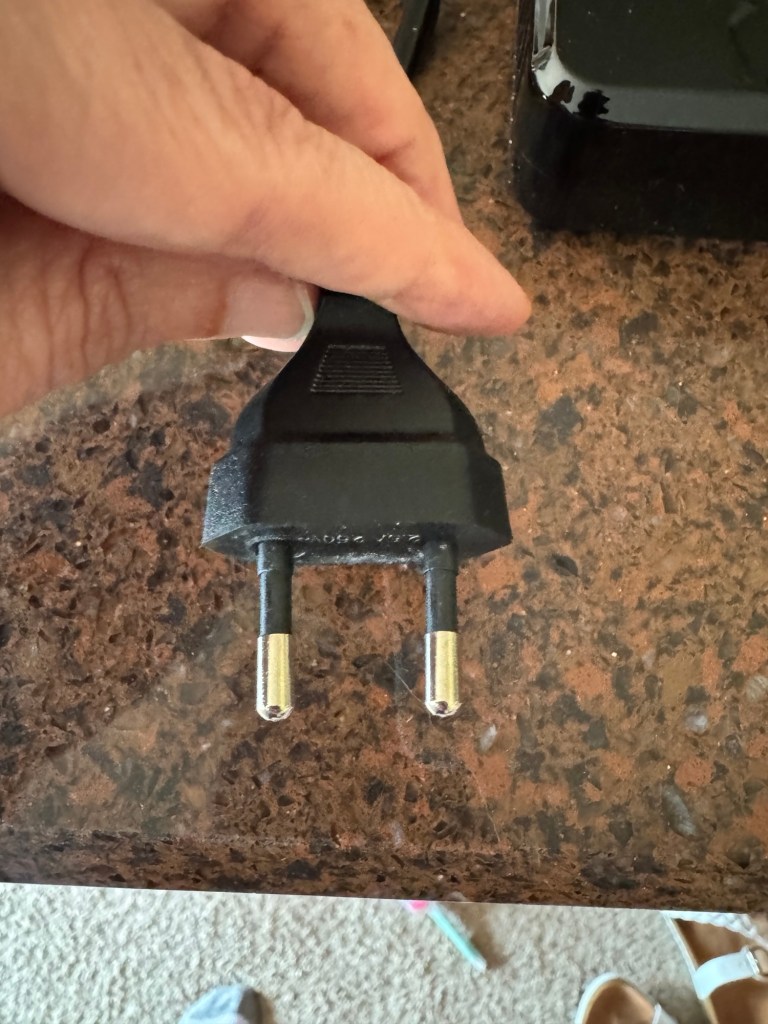
8) Power adapter AND converter – you will need this one:

You need a converter AND adapter
The Internet provided conflicting advice- this is the plug I needed

9) While we’re talking about power – bring a power bank for your phone. You will take so many pictures and videos and your phone will constantly be looking for wifi and cell coverage that the battery will drain fast. You don’t want to be without battery power while you are out exploring. I usually gave my phone an extra zap of charging during lunch just so I could top off the tank, so to speak.

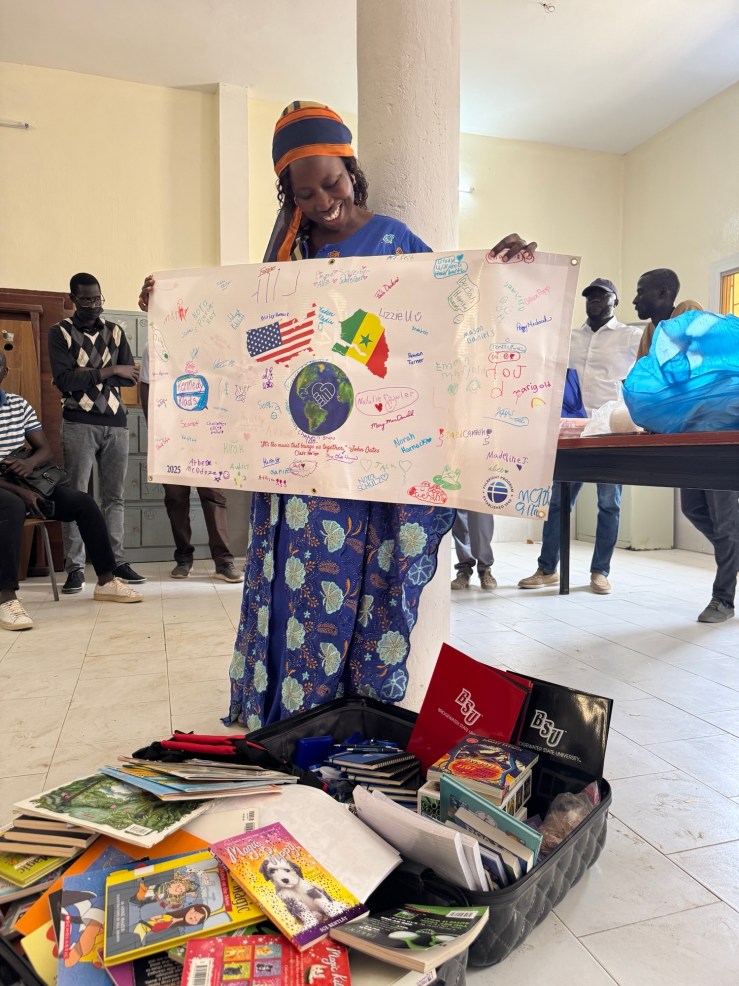
10) If you are traveling for a Fulbright, you will need to bring gifts for your host teacher, the students, etc., as they will be showering you with gifts and you want to be able to reciprocate. For this, all teachers who host Americans have been to the US, so I asked my host teacher what she missed from being in the US. She mentioned certain lotions and chapsticks she can’t get in Senegal, so I brought a bulk thing of Carmex for her (her preferred chapstick). I also collected books, card games, and other English learning aids from my school families to donate to her school. I know one of my travel companions brought chalk as well, as supplies are hard to come by. For the students, I had the students I work with make postcards for the Senegalese students – they talked about their favorite things and what they do in their free time. Sara had her students make postcards and then had a QR code for students to scan with their phones to see pictures of her students. I also had the students from my school design a sticker that represented Senegal and the US together, and had it made through Sticker Mule. I handed those out to everyone, and adults and students alike loved them. The students also really loved trying American candy! We were there for Easter, so I also brought jelly beans to share with my host teacher’s family who had us over for Easter dinner. I did not want to come empty handed! Hopefully this helps get you started with some brainstorming.

Our donations and a banner that all of the students in my school signed

11) Dramamine – even if you have never been carsick in your life, the roads are very bumpy and rough and the driving is a bit more erratic, so people in my cohort who don’t usually have a problem with this found themselves struggling a bit. Bring some just in case.

12) Snacks – the eating schedule in any foreign country tends to be different than what you are used to. It’s always good to have snacks because you never know when your next meal will be. Even knowing this, we sometimes had to fight off hangry feelings!

13) Your adventurous spirit – travel to any foreign country is a gift. You obviously wouldn’t choose to do so if you weren’t adventurous. However, sometimes when you get tired, you just want to curl up and go with what you are most comfortable with- whether it’s a meal choice, an activity choice, or choosing to just go back to the hotel. Fight these impulses. Traveling somewhere different is tiring, both mentally and physically, but make the most of your experience. Try the weird-looking food; go to one more museum. You won’t regret it when you are back in the comfort of your own home. I promise.

Other tips for travel beyond what to pack- I sprayed all of my clothes with permethrin. I had a friend who happened to have an extra bottle of the stuff, so I sprayed all of the clothes I was bringing. It helped a lot.

I got the following immunizations: from the travel clinic – yellow fever and typhoid. From Walgreens – meningitis, a measles/mumps/rubella booster, hepatitis A, and hepatitis B. The travel clinic recommended that I get the other vaccines from Walgreens due to the fact that the travel clinics do not accept insurance (mainly because insurance doesn’t cover the usual travel immunizations), so the ones insurance does pay for can be received at Walgreens. The travel clinic also gave me a prescription for the anti-malarial pills and a basic antibiotic for any stomach issues I might develop while traveling and eating things that are different than at home.

Be prepared to negotiate – both market purchases and taxis involve haggling. It was not uncommon to offer a seller 1/3 of what he or she was asking as my offer. My host teacher and the country host both said we would end up paying more because our skin was white and they knew we were American. Do not be afraid that you will insult the seller, as this is part of the back-and-forth that takes place. If you watch two Senegalese people haggle, there is a very awesome rhythm to it, and it looks heated. It isn’t, and both parties usually smile at the end.

ATMs – if you plan to use ATMs for local currency, some of our cohort had a hard time finding some. The one in our hotel was broken most of the time. It is hard to exchange money in some areas. There is a currency exchange in the airport, and we had one in our hotel. I changed over all of the money I got from my Fellowship, hoping that I wouldn’t go over that amount. It was totally fine. Many of my colleagues had a hard time, and Senegal is not known for taking credit cards anywhere (including stores, taxis, museums, and restaurants).

GPS is inaccurate in Senegal. Drive times are very wrong and routes your driver will take are often not in the maps. Make sure your itinerary is not tight time-wise, as you will not get it all in.

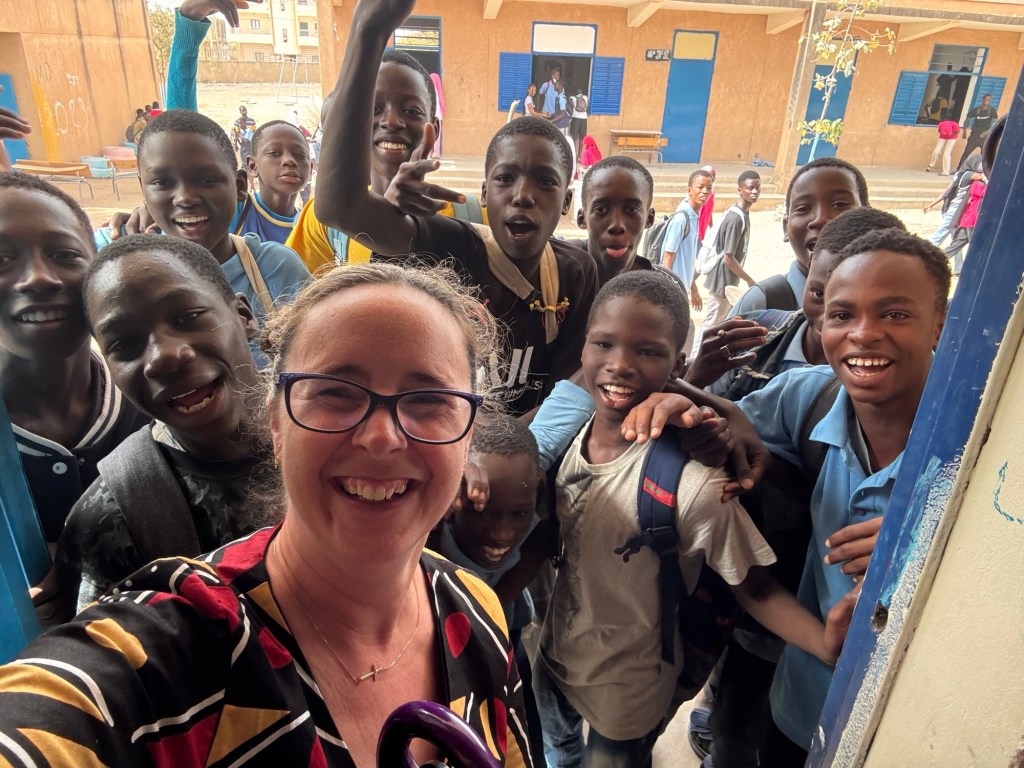
Going to a school? Know that the students will laugh when they see you. It took me a long time (ok, like a few uncomfortable minutes) to realize that they weren’t laughing AT me- they were nervous to meet me. Don’t be afraid to approach students (they’re going to call you over to them anyway) and just talk to them – they will be nervous about their English skills and you will be nervous about your Wolof and French skills, but it will be so rewarding for you both!

Trust your instincts- some of our cohort members had moments that were really rough. There are bad people everywhere in the world- people who will try to take advantage of your desire to help. If it starts feeling wrong, contact your IREX in-country consultant. They will help you, and they can’t do that if you don’t tell them what is going on as it is happening. Don’t wait until you return to Dakar.

If you are a Fulbright fellow- finish your website deliverables before you leave for your trip. Then you can just focus on your guiding question, and enjoy the experience. When you get back home, you will be so busy processing what you just did that you won’t really want to hammer that out, too.

What Teranga really means

Teranga. This word means the world to the Senegalese. Roughly translated to ‘hospitality,’ it is the mantra of the Senegalese people. However, I think teranga means so much more than hospitality, based off of what I saw.

Teranga is greeting people – all people – with a smile. Differences in religion and skin color are respected and encouraged. Muslims and Catholics are married regularly in Senegal, and it is not uncommon for families to have Catholics and Muslims both.

We had just arrived to the school and these girls called us over – they wanted to meet us right away!
This is a picture from our welcoming ceremony – people were seated behind us and standing, stretched out on both sides of the canopy! The community came out to greet us!

Teranga is sharing your meal with anyone who needs it – whether you have a lot or not. This includes the neighborhood children, friends, family, and people you have just met a few hours earlier.

This is how meals are shared – all together in one bowl. Meals are a community event!
These cute girls joined us for lunch one day, as my host teacher usually invites them to eat lunch when they come around
These fishermen invited us to dinner one night as we walked past.
The fishermen eating their day’s catch, and sharing it with us!
There is no possible way that fish could be any fresher than this – eating it fresh off of the fishermen’s boat, grilled on the beach while sitting in their fishing hut.

Teranga is giving gifts to an American even if your family doesn’t have much to give.

Snacks to try and bracelets from multiple students
A different day of bracelets from other students
This group of girls gave Sara and I makeovers. Then, we held a dance party, and they were so respectful of our space – they would always remind each other not to crowd us too much. They would grab our phones to take videos and pictures of us having fun. It is one of my favorite memories, as these were students we did not get to teach during our time at the school – they were from the middle school side of the school. They were not comfortable with their English, but we all understood fun and the joy of being together.

Teranga is acknowledging someone’s strengths, particularly if they are different than your own. Students would often point out the really good musicians in their classes once they heard I was a music teacher, and encourage their classmates to sing for me.

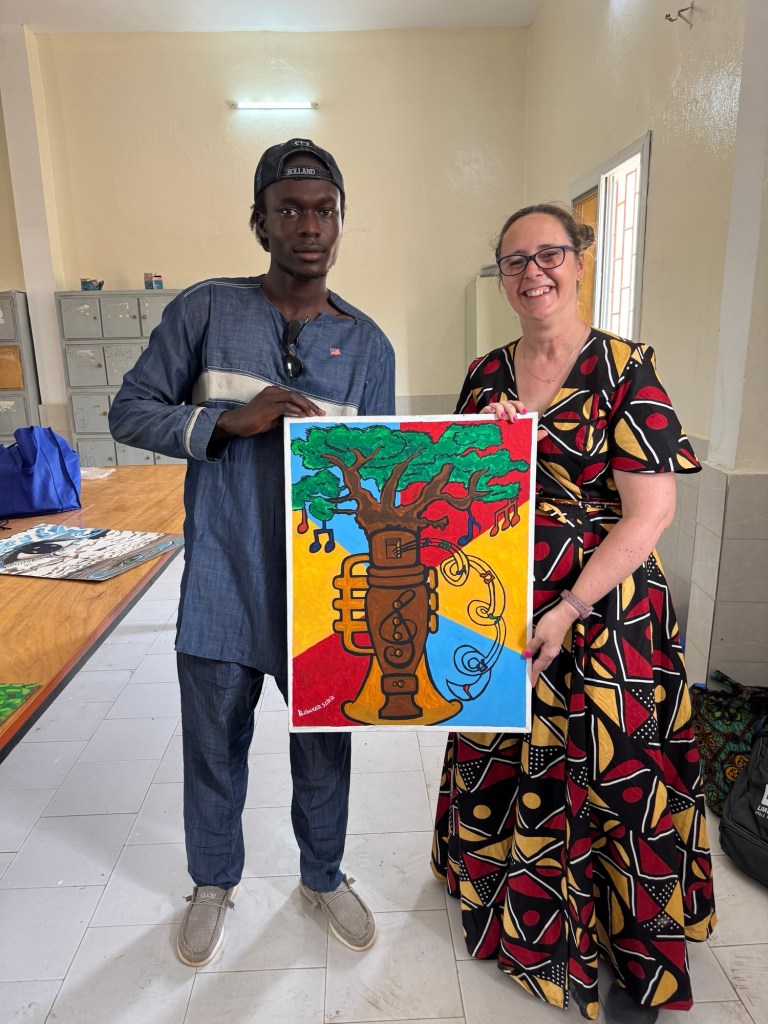
This artist used his gifts to create an original piece of artwork for each of us!
This music class met on a day it wouldn’t normally, with a teacher who came in special just to show me what music looks like in Senegal schools (because my school placement did not have music). The teacher isn’t even their music teacher – he is the president of the country’s music teacher association, and he ran class with these students he didn’t know just for me!

Teranga is welcoming foreigners into your closed building for a tour. We toured so many buildings that were closed, just because we were from the United States. Can you imagine how we would react if someone from another country wanted to get into one of our locked buildings? The police would be called; it would make the news!

This is the room where the president of Senegal meets with VIPs in the Dakar International Congress Center (where the president makes all of his public addresses). The building was closed when we toured it.

Teranga is helping others – whether you know them or not – with whatever they need, just because you are right there.

These two students traveled to Dakar to attend the English Day event we were going to be at!
Our wonderful host teacher told me at the end of our stay that she doesn’t like water. She told me then that she was really not a fan of being on boats, either. I was surprised by this, as she took us on this incredible sunset boat cruise in a bird sanctuary, and she took us on a boat tour of Pink Lake. That’s an incredible amount of teranga to do something you don’t enjoy in order to show your guests everything your country has to offer!

Teranga is SEEING someone – truly seeing who they are, what makes them happy, what type of person they are. Although I only spent 2 weeks in the country, there were people who figured out what my beliefs, strengths, and style were better than people I’ve known for years in Wisconsin.

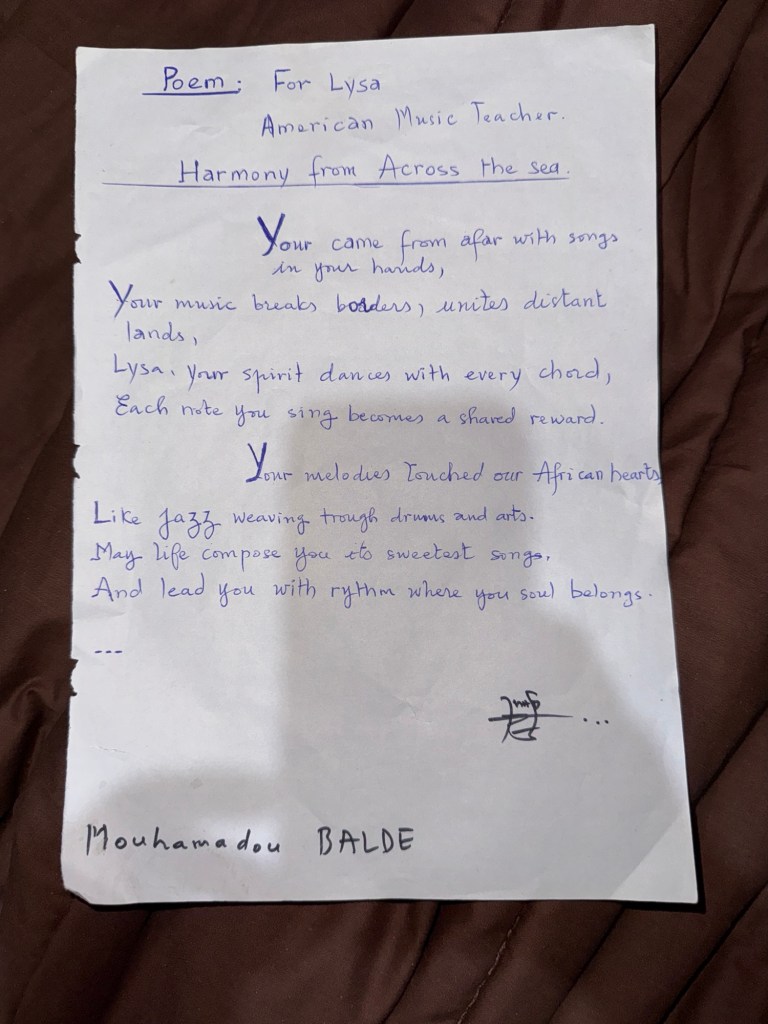
This boy wrote the sweetest poem to me, and wrote one for each of my travel companions, too.
Wow.

Teranga is always greeting someone when you meet them. It is rude not to smile and offer a lengthy greeting each time you arrive, pass someone, or want to talk to someone. This was an important part of our school day – each morning, we greeted the other teachers and the headmistress. If you have a simple question for someone, you must first greet them and take an interest in them – not just walk up and ask your quick question, no matter how hurried you are.

The mayor of the city wanted to meet us when he heard we were in his area.
These two sweet girls came running up to Sara and I to give us hugs. We then danced with them for a while.

Along those lines, teranga is having a smile for everyone. I know I have been back to the US for a while, but I really meet all of those smiley greetings and friendly faces! Senegalese people understand the importance of building relationships!

These boys heard me playing the trombone for one of our classes, and hung outside the classroom door watching. Music always brings people in….

What school is like in Senegal

The absolute best part of the Fulbright Teachers for Global Classrooms program is visiting the schools, getting to know the students, and getting to teach with our host teachers!

Because of this experience, I really got to see what school in Senegal is like. These are my observations to help paint a picture of what life is like for Senegalese teachers and students. I know many of the people I’ve talked to have asked about schools in Senegal, so here you go!

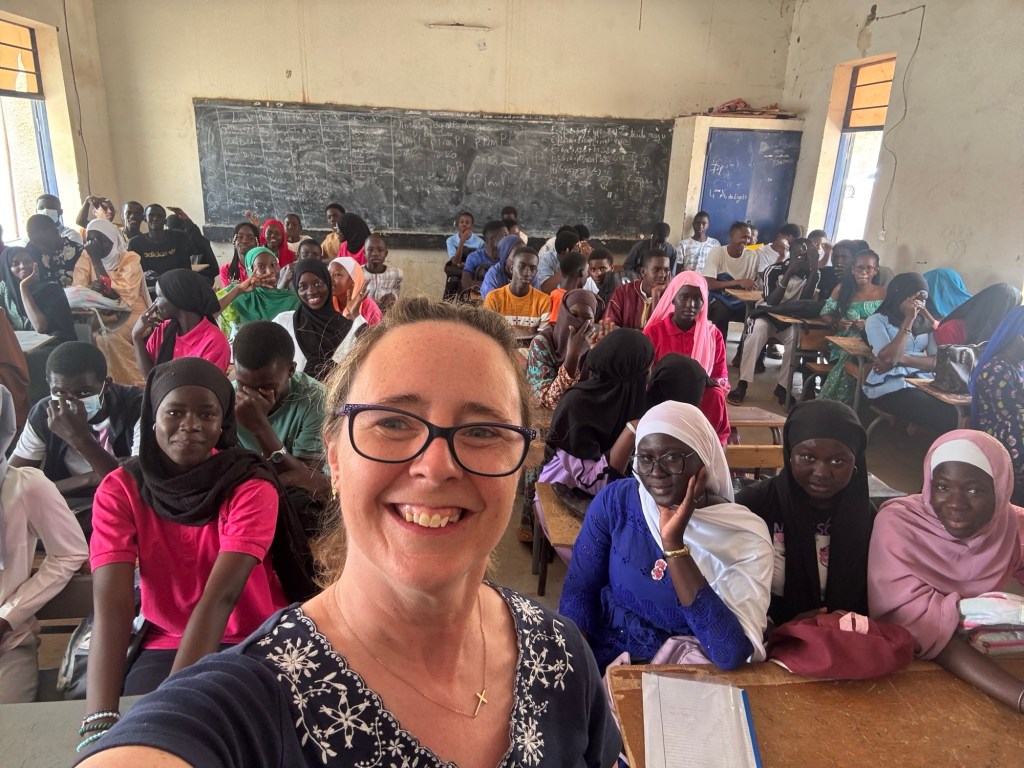
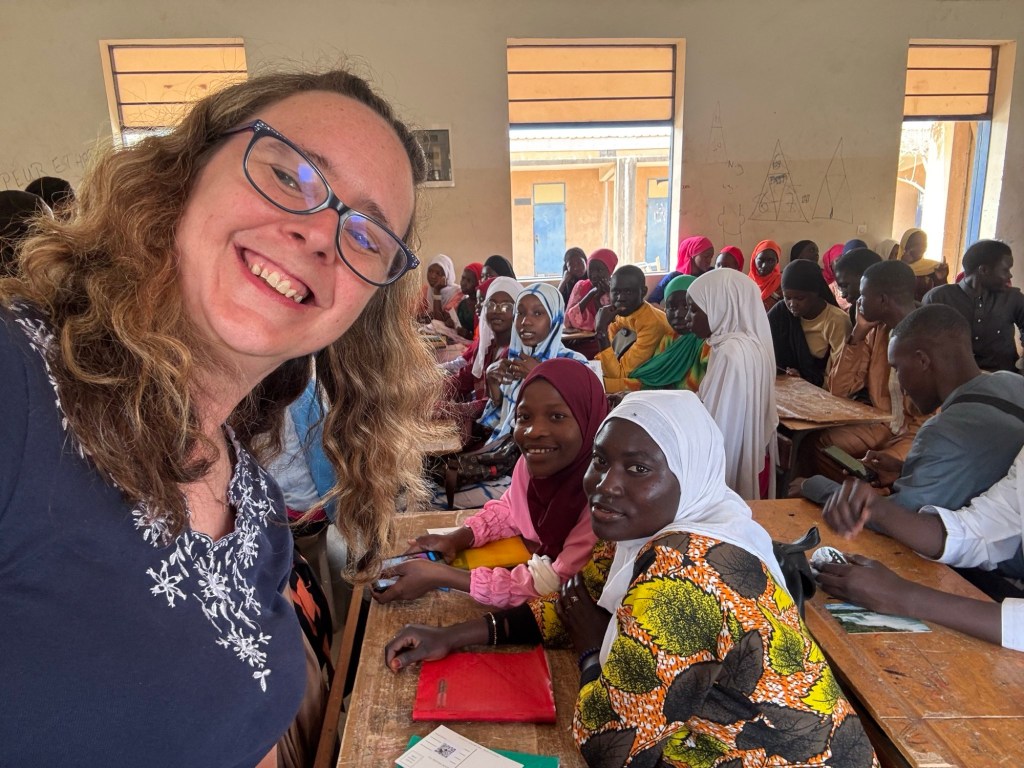
1. There are anywhere from 60-90 kids in a class. I was in a school that housed middle and high school students, and the high school students all sat three to a desk. The room is FULL!

This is before class, so there are a few students still coming in!

2. Everyone walks to school. It is really cool to see all of the students parading down the dirt road to get to school each day.

Coming into the school in the morning

3. Teachers use a chalkboard and chalk to teach to their students. There aren’t projectors, wifi, computers, etc. in every classroom, though there were 3 computers in a room that could be used if someone needed them. However, don’t feel sorry for these teachers – they are incredible teachers regardless of what resources they have! In fact, I learned a lot by watching these masters hold the attention of a room packed full of students.

My wonderful host teacher, teaching English

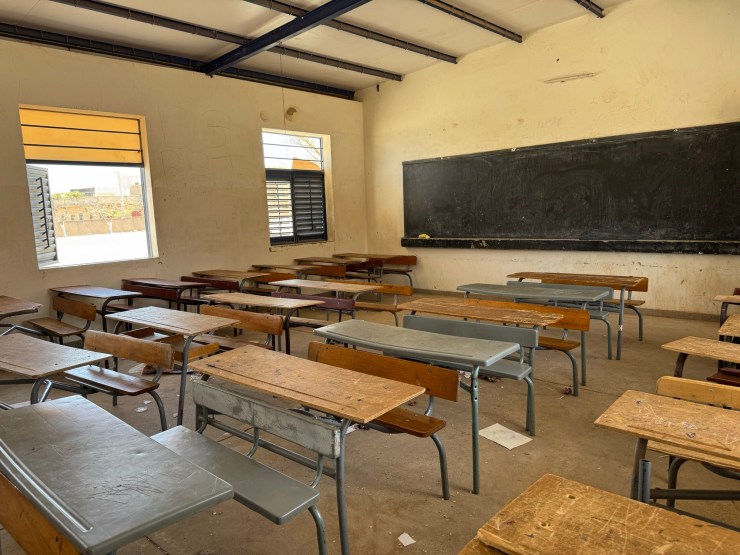
4. The classrooms have an open-air feel, as they don’t have window glass, and the doors are kept open for cross breeze. It never felt really hot in the classrooms, despite it being in the 90s temperature-wise, and having no air conditioning.

Windows with no glass – only shutters

5. On Fridays, students can wear whatever clothes they would like, rather than the school uniform they wear the other days of the week. Friday is a religious day, so students come to school in fancy dresses and formalwear. It is very different than what the students in my school choose to wear on their Fridays (jeans and t-shirts)!

School uniforms
Friday attire

6. School break runs from June to October, as this is the rainy season. There is a lot of sand and dirt everywhere, and the classrooms would get horribly hot if they had to close up the windows and doors, so students have off.

The school!

7. Students have free periods in their schedule, where they hang out in the courtyard and just talk. This is unsupervised time.

Students just hanging out, waiting for their next class

8. Food is sold for students during the day, and students eat it during their free blocks.

Snack food – lots of nuts and fruits
More snack foods
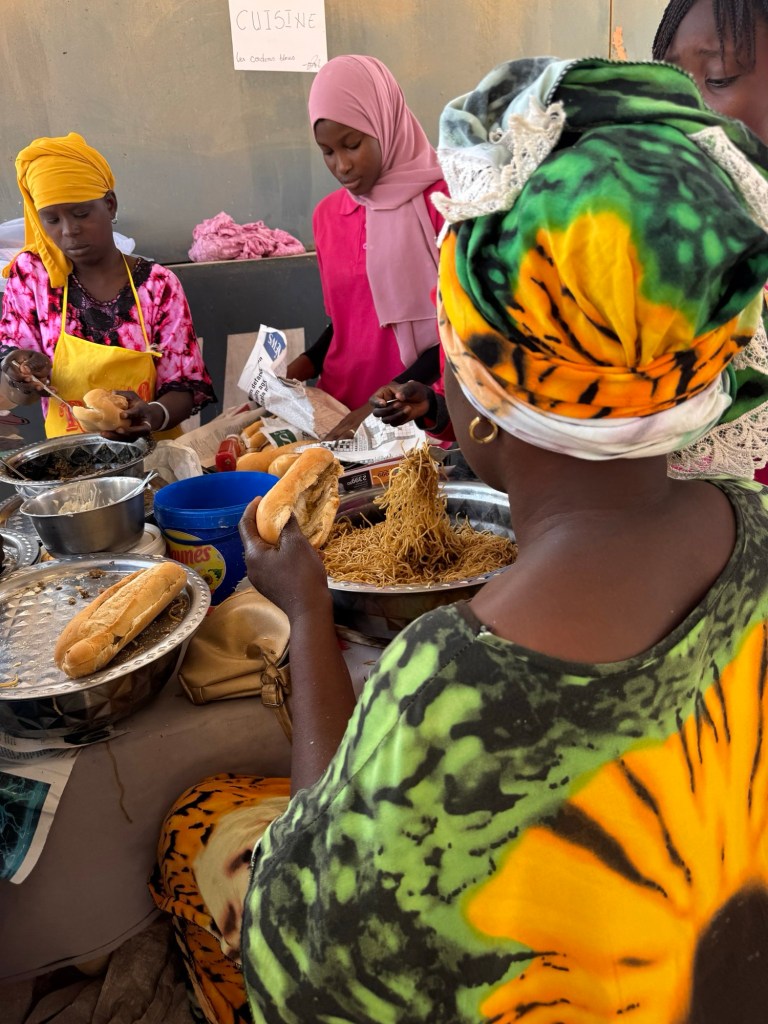
Making sandwiches to sell to students, as well – they were delicious!

9. Substitute teachers don’t exist. If the teacher can’t come in (illness, family event, conference, etc.), then the students just don’t have class that day.

My community school placement

10. Punishment (both in class and with the headmaster) involves students kneeling on the ground with their head up against the wall or blackboard for a length of time. I did see this, but did not take pictures of that! It’s bad enough being in trouble – no one wants to see a picture of themselves in trouble on the internet!

11. Students generally like school. The majority of them have a positive attitude in class and really participate in classroom discussions.

They’re ready to learn!

12. The headmaster or headmistress (principal) is the teacher in the building with the most seniority.

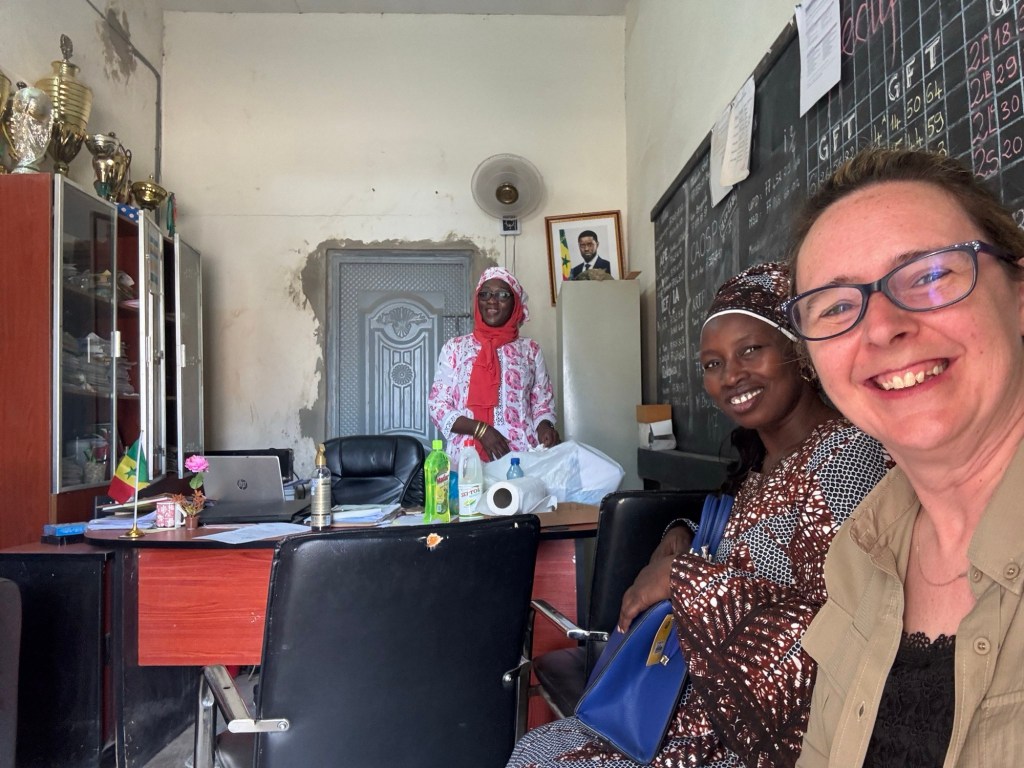
In the headmistress’s office with my host teacher, waiting for school to start
The headmistress, thanking us for our time in Diamniadio

13. Teachers in Senegal are placed in their first teaching job. After that, they can choose to go wherever they would like to teach when an opening comes up.

This is the college my host teacher went to in order to become a teacher.

14. Teachers are required to retire when they are 60 years old. The teachers are very upset about this, as once you are a teacher, you may not hold another job. Once you stop working your teaching job, you can’t make money anymore, so people go from a decent wage to getting paid nothing and living in poverty.

Senegal is….

I’ve been home for 4 days now, and I went back to work immediately upon return to the country. There have been some very funny moments that have made me laugh, as I try to reenter American life. Yesterday, I was brushing my teeth, and had a freakout moment when I realized I had just used tap water to rinse my toothbrush. For 17 days I had used bottled water exclusively, even for teeth brushing. How funny that the instinct stayed with me, even after having been back for days (and yes, I did brush my teeth in the days between my return and this moment…not sure why it got me all of a sudden). I also have had a dream about being in Senegal every night since I’ve been back. Nothing earth-shattering, but definitely seeing the faces of the students I met and teaching has left a deep impression on my subconscious! And, there is the joy of continuing to take my anti-malarial pills for 7 days after my return…

This all got me thinking about how I would describe Senegal. I have had so many incredible conversations with my friends, family, and colleagues, as they dig deeper through things that I didn’t put in my blog. However, I feel a strong desire to try to package this experience into a few words for when that casual run-in with someone who asks “So, how was Senegal?” and is looking for the super succinct answer. I have come to the conclusion, though, that my determination to try to simplify this experience into a sentence or two truly does the country, its people, and the fellowship a great disservice. This exercise did, however, produce some fun memories that made me laugh. Here’s what I have come up with, in terms of describing Senegal (and the experience itself):

Senegal is seeing the biggest, most beautiful smiles on the curious faces of students who believe learning English is the only way to be successful in their futures.

Senegal is noise – all the time – whether you are in a city or smaller community, whether you are in a market or a classroom.

Senegal is the giggles and whispers as you walk through a school, as students have never seen a white person before (this always made me self-conscious until one of the students told me that they were all just so nervous to speak English to us, and the US is so highly respected there).

Senegal is Teranga, in a way that cannot be expressed by the traditional translation of ‘hospitality,’ because it is so much more than that.

Senegal is being uncomfortable, but never feeling unsafe.

Senegal is raw beauty – both in landscape and people.

Senegal is an understanding of what is truly important.

Senegal is sand everywhere – I would leave the bathroom after a shower and immediately have sandy feet again, and hopping into bed each night involved encountering sandy sheets!

Senegal is a dichotomy of old and new – modern cars and semis traveling next to horse-drawn carts, new buildings being placed next to buildings that have seen many historic events.

Senegal is a 4:00 pm lunch, and thinking breakfast was so long ago that you might eat anything placed in front of you before asking what it is.

Senegal is colorful fabric and no person ever wearing the same outfit as anyone else in the country!

Senegal is food with incredible flavors shared in one bowl with everyone you are lucky enough to dine with.

Senegal is music…all the time, but not in the way I expected. (I write this as I listen to my new favorite mix of mbalax songs.)

Senegal is a giant leap out of your comfort zone.

Senegal is haggling – taxis, markets- there’s a whole art and rhythm to the negotiations that is fun to listen to (and even to participate in).

Senegal is the beautiful cacophony of multiple mosques calling the Muslims to prayer.

Senegal is not knowing what you might experience when attempting a public restroom visit….

Sometimes it was a toilet, sometimes it was this. Sometimes there was toilet paper, but most of the time there was not. Most of the time the whole bathroom was very wet, as they often wash the whole place down after each visit…

Senegal is hot!

Senegal is a conversation that artfully switches between Wolof, French, and English several times in the span of a few minutes.

Senegal is a place where EVERYONE is still out in the streets, even at 10 pm – the busiest markets look the same at noon as they do at 10 pm!

Senegal is wondering whether you will have electricity at your hotel that night.

Senegal is stopping the car and yelling out the window to the group of people in order to get directions to where you are going.

Senegal is the gateway to West Africa, as Dakar is a major port for anything entering all of the countries of West Africa.

Senegal is a country where sometimes there are roads, and sometimes you make your own roads.

Senegal is waiting 15-20 minutes for each picture you put in your blog posts to upload, sometimes having to try several times before it finally goes!

Senegal is a place that changes you – you will not be the same after visiting it.

Senegal is gratitude in all directions.

And, Senegal is a place that once you’ve visited, a piece of you will be left behind when you return. It is an experience that will never leave you and you will never regret your visit.

Definitely missing my Senegalese friends, the students, and my colleagues from the Fulbright Teachers for Global Classrooms Fellowship.

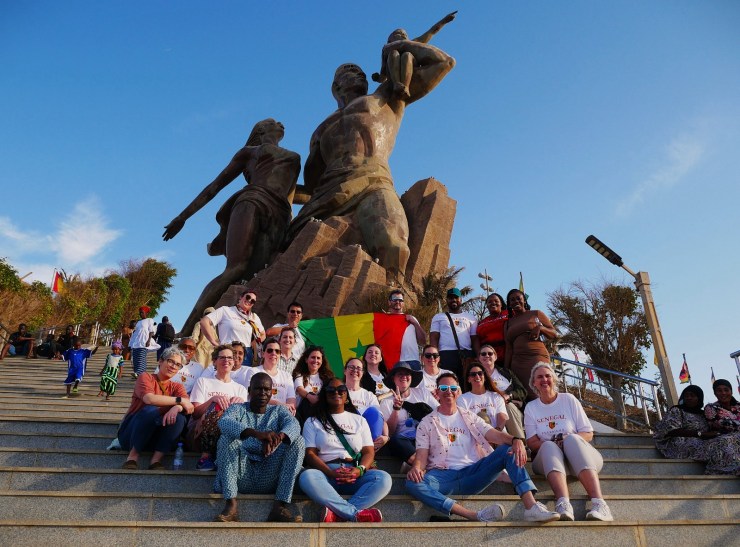
Fulbright cohort in front of the Renaissance monument

Lisa’s Guide to Driving in Senegal

I think the fun thing about traveling anywhere is seeing what the traffic and driving patterns are in any new spot. Every place that I have been has had its own unique driving style, and I am always happy to use public transportation or let others drive in new places because of this.

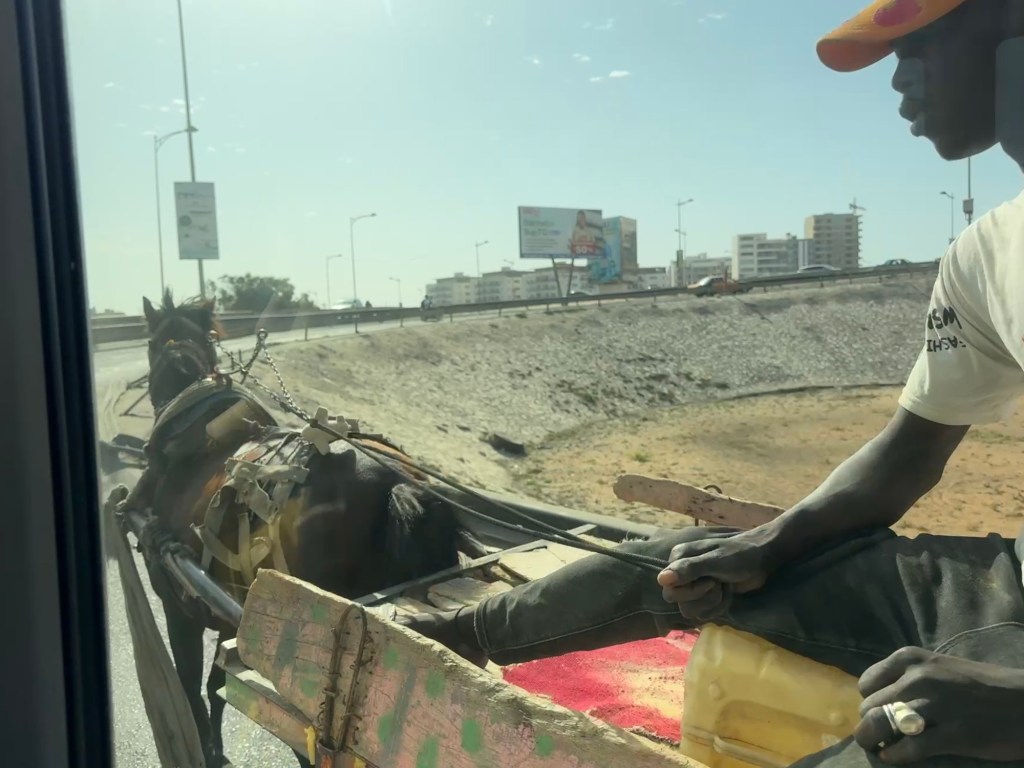
Senegal did not disappoint in this area, either. We were on our way to the city from the airport on our very first morning in Senegal. As we were driving what would normally be considered a busy interstate in the US, I noticed there were carts being pulled by horses (called ‘charrettes’) on the same fast-moving, multi-lane highway. I found this amusing, but also grew to love the contrasts between that mode of transportation and the zippy motorcycles and mopeds weaving between cars and semis on the highway!

Passing a charrette in Dakar, while on our bus on the way to the hotel from the airport
A nice mix of modern and traditional transportation

Additionally, I observed the most interesting rules of the road in Senegal. Consider this my “Guide to Driving in Senegal.”

First, the lines between lanes on the highways are often non-existent. The locals don’t have any trouble with this, but for me this took a little getting used to. However, that said, when there were lines, it appeared they were optional to follow, as well. Often cars and other motorized vehicles would drive wherever they wanted to get around slower cars.

Our lane is somewhere here…..

Roundabouts also appear to be an interesting event in Senegal – the cars were coming at us from all directions…..

Traffic in Dakar

Speaking of going around cars that are driving slower than you – as far as I can tell, the entire country is considered a ‘passing zone.’ The proper technique to let others know you’re passing them (and also to let oncoming traffic know that you are in their lane) is to flash your lights. This flashing of headlights would happen if you were following someone in the same lane as you who is driving faster (letting them know to get out of your way). The flashing of lights would be used to let oncoming traffic know you were in their lane and would be there as they continued towards you, so maybe they should slow down or go off the side of the road. The flashing of lights was also used to let someone who looked like they were going to pull out in front of you that the idea of such a thing was unwise. If things looked particularly dicey, the horn came into play to let those drivers know not to cut you off as well. Lights communicated a lot!

I bet you are wondering with all of this passing, and the light-flashing at intersections, how does one decide who has the right of way? I will tell you – it is the person who is unwilling to yield to anyone else. After much observation, I can tell you that the right of way is given to the person who has less to lose! Sometimes this becomes open for a loud debate….

In fact, if you are merging into a tollbooth, or onto a highway in a congested traffic area, the best thing to do is to roll down your window and discuss it with the driver of the vehicle that you are hoping will let you in. This ‘discussion’ is best done while still nudging your car into the real or perceived gap you are trying to fit into. Sometimes it may not be possible to slide more than a few sheets of paper between each car!
Traffic in Dakar……eek.

How do the Senegalese find their way to locations? While in the US, everyone has their favorite navigation app – be it Google Maps, Apple Maps, Waze, or any other fun variation on that familiar theme, the Senegalese use something different: other people. The Senegalese in general are usually outside – walking, eating, shopping at market stalls, talking with others – they are a very social group of people. There is ALWAYS someone nearby. Whenever we went somewhere, my host teacher would always end up rolling down her window, greeting people in Wolof, and asking for directions. Most times the people would know where she wanted to go, but other times they would point her to the next intersection where we would roll down our window and repeat the greeting and question. Sometimes it would take us only one stop to find our location, and other times it would take us over 7! Who needs GPS?!?

This is what our area looked like at every hour of the day – from early morning until past 10 pm!

Now one thing that is very interesting is how often our driver got pulled over. We rode with the same driver for the 9 days we were in Diamniadio. During that time, he got pulled over 7 times. The police set up at a spot on a road, and then stand outside their vehicles. If they point at you, you must pull over and wait to find out what you got pulled over for. Often, these stops took some time, as the police were hoping you would just pay them some money to continue on your way in a timely manner. One time, our driver was pulled over and they told him his license was being taken because he was wearing sandals to drive. Do you know how they knew from the road that he was wearing sandals? They didn’t. They couldn’t find anything else wrong with what he was doing, so they cited him for that. The next morning, he drove to the City Hall, paid his fine, and got his license back. The funny part? He did all of this in the same sandals he was wearing the day before. The other things he got pulled over for was the tint on the windows and our host teacher not wearing her seat belt. We didn’t hear the other reasons why he had to pay fines.

A familiar sight in the mirror….

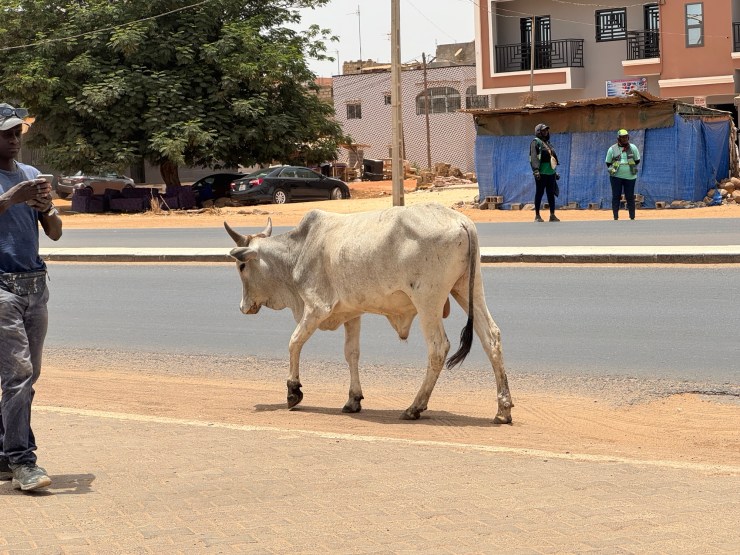
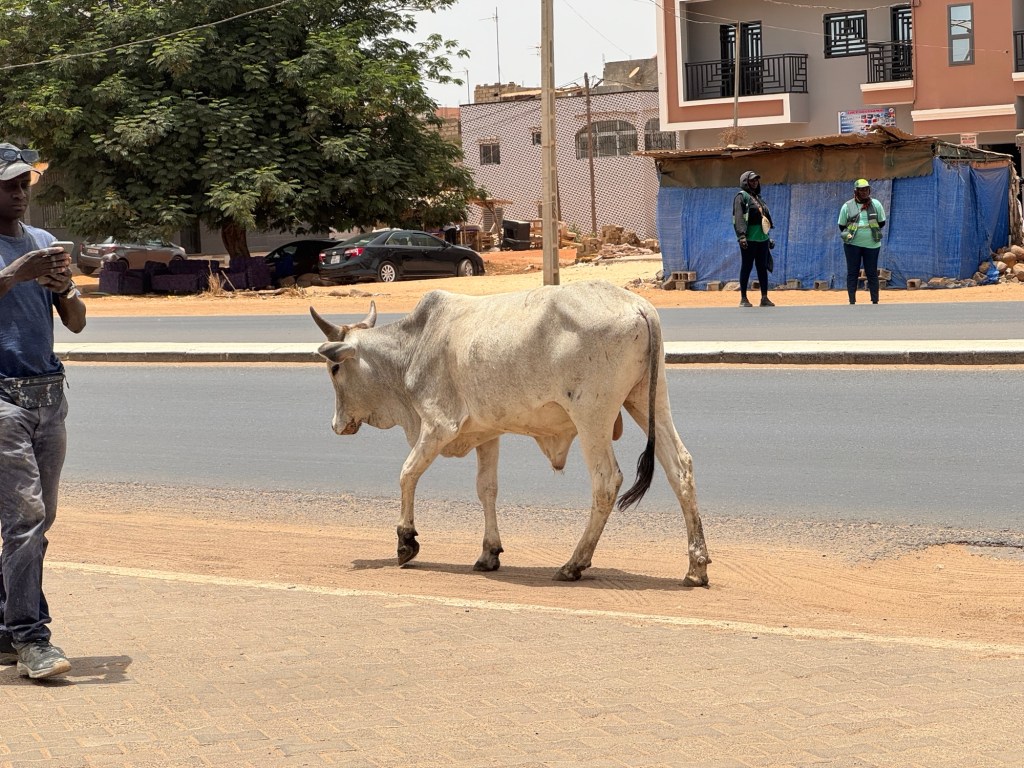
Other fun things to watch out for? There are cows everywhere! I’m pretty sure that due to their size, they get the right of way…

Mooooooooooo.

Also, don’t be scared of the people hanging off of the back of vehicles. People use these vans as public transportation, and there isn’t a capacity. People will sit practically on top of each other, stand, and hang off of the back to get to where they need to go.

Car rapides, or Ndiaga ndiayes

Let’s say you are driving in Senegal, and the concrete road ends. What do you do? Keep driving, of course. The major roads are paved, but driving around through the towns are all done on dirt roads.

A neighborhood
The drive to school….sometimes we would drive around the soccer field, and sometimes we drove through it….

Now, you might be thinking “Why would I want to drive with all of this hassle?” Well, you might want to know that I am pretty sure Senegal may have been doing “curbside pickup” for much longer than we have been doing it in the US. For us, it mostly started during COVID, but I can imagine the Senegalese pulling up to the roadside market stalls and purchasing the freshest fruit from their favorite vendor decades before 2010! What better way to pick out your produce than from the comfort of your own passenger seat?

Who wants mangoes?

So, now that you know how to drive in Senegal, are you ready to give it a go? If not, I can assure you the taxis and the train are great options! Just make sure you negotiate the price of each taxi ride BEFORE you get in the car!

It’s Happening!!!!
Last week, we got our official itinerary for the remaining portion of the trip, and I have started my anti-malarial pills. This journey is a GO! I repeat, this is not a drill!

I am off to Senegal on Saturday. The journey to this point has been long and, at times a steep climb. There was a 10-week course on global education that started the week I got off of the NOAA ship last fall, and ended a week after I got back from Antarctica. That was an intense time, as I had so much to do for the other experiences, and wanted to make sure I did those justice for the student experiences to follow.

I found out my placement in Senegal right before Christmas, but not where in Senegal I would be (that came in January). We traveled to Washington DC for our Fulbright Global Education Symposium , and met the other people traveling to Senegal with me. There were 15 of us, and every one of the teachers in my cohort inspire me! They are great people!!!

Fast forward to the anxiety of watching budget cuts at the federal level to the US State Department, Department of Education, and the US Embassies around the world (all of which are involved in the Fulbright programs). There was a Moroccan cohort that was supposed to depart before us (on April 4). They found out on March 21 that they would not be able to go due to their funds being frozen. At that point, I was pretty sure I would not be going to Senegal.

However, we ended up adding 5 of the Moroccan cohort members to our Senegal crew. Our hotels are booked, flights paid for, and it looks like We. Are. Going!

Once you have convinced yourself that you are not doing something, it’s a little hard to wrap your brain around the fact that you are indeed going to get there. I didn’t want to get excited, so that way I couldn’t feel disappointed. I kept telling myself that if I didn’t go then I would be able to be with my family for Easter. I would be able to accept a really incredible alumni award at my university. There were perks to staying home, for certain. But now it is time to get excited for the adventure.

Stay tuned for how this journey goes – it should prove to be another fascinating voyage. I am hoping to find examples of music being used as a means of cultural identity and storytelling, and I want to find examples of similarities between Senegalese students and the students at my school. I know there will be differences, but I think the students will be fascinated to find that they have things in common with students across the globe. I can’t wait to see what their schools are like! Bring on the adventure!!!!

One full suitcase of donations from my school! There’s more in my other suitcase, too! My host teacher is going to be so excited!!!!
Every day at 4 pm our time I’ll be taking this pill- 2 days before the trip, during the trip, and for a full week after. The state department video we were required to watch on malaria was terrifying!
Here I go! See you on the other side! This time tomorrow I’ll be in Dakar, Senegal! 🇸🇳
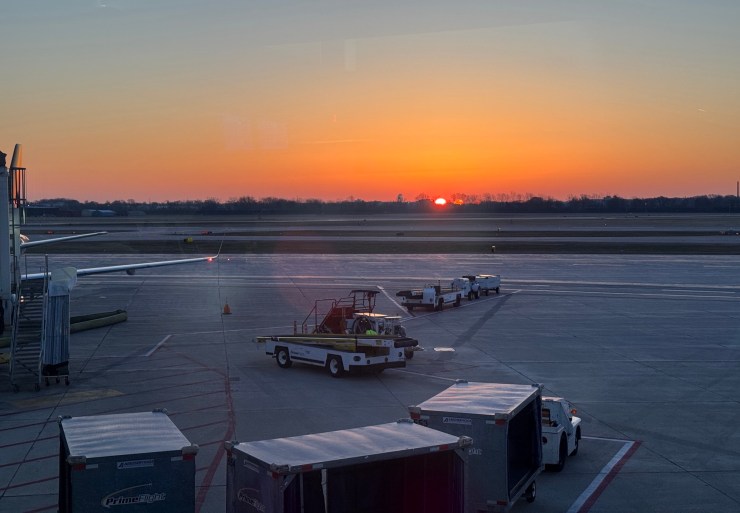
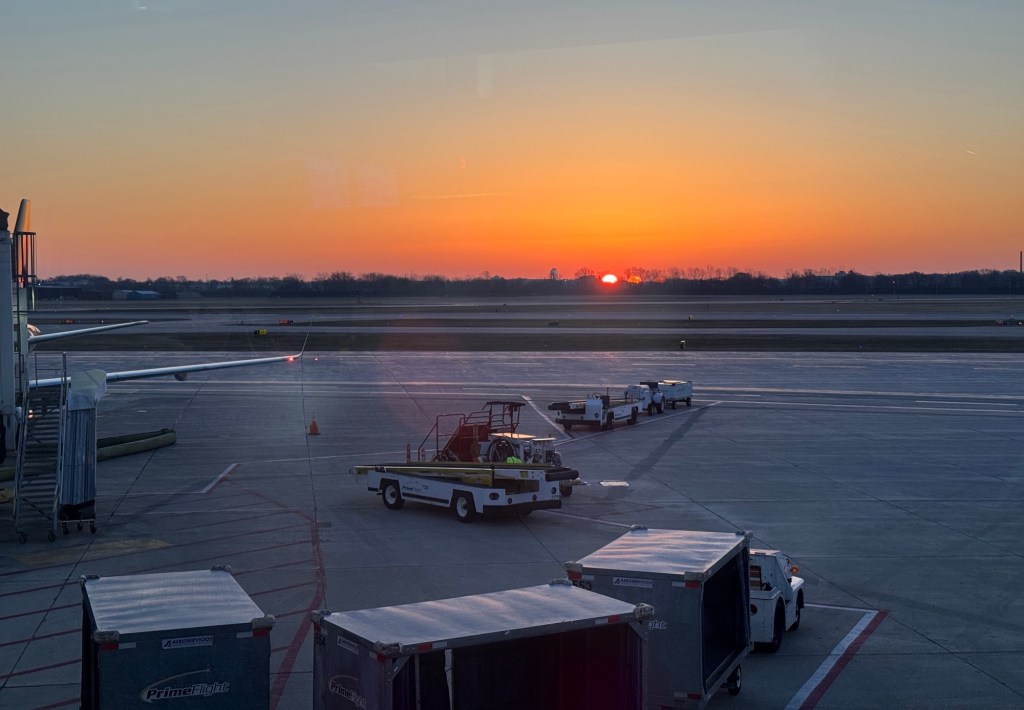
Watching the sunrise since I was at MKE at 5:30 am

Preparations Are Underway…..

For those of you who have never traveled out of the country, depending on where you go, you may need additional vaccinations. As it turns out, we didn’t NEED any additional vaccines (there had been a law that ended in December of last year that required all visitors to have a yellow fever vaccine before entering the country), but there are a mess of vaccines encouraged. I went to a travel clinic in Brookfield, as my doctor recommended going there for one-stop shop of all of the vaccines. Travel clinics don’t take insurance, though, and most travel vaccines are not covered by regular insurance anyway. The travel clinic that I went to was nice enough to let me know which vaccines I should get that my insurance would cover, and encouraged me to go to Walgreens or CVS to get those. I was very appreciative to them for that hint.

Yeah, I just casually had typhoid in my fridge for a few weeks. I had the choice of oral or injected typhoid. The oral lasted 3 years longer and cost $20 less, so I went with that. This also allowed me to take it home, keep it in my fridge, and take it anytime up to 2 weeks before I leave. I finished the doses last week, which was nice because I could wait a week after I had the yellow fever vaccine to start on typhoid (and wait until the musical I was playing in was over)!
Last day- thank goodness! That was the roughest as far as side effects went – YUCK.

Today I went and got the final vaccines from Walgreens – Meningitis, MMR booster, and a combo Hepatitis A & B. I have to go back right before I leave to get the 2nd dose of the Hep A/B, and then I’ll go when I get back to finish the 3-dose regiment, but then I’ll be immune for life. That’s the nice thing about the yellow fever vaccine, as well – it’s for life.

Even more shots!

Now, in addition to shots, our school is working on collecting donations for the Senegalese school I will be visiting and teaching at. My host teacher has asked for supplies to help students learn English – books, flash cards, and games. So far, everyone is so excited to help.

Additionally, the students are designing a sticker for me to give to the Senegalese students I meet that will symbolize the friendship we hope to develop with them. I’m so excited to see these made and to hand them out to everyone I meet!

Just a sample of the stickers the students are designing…there are so many great artists in our school! One elementary design and one middle school design will be made through an online sticker company for me to hand out in Senegal!

The students I teach are going to write postcards to the students in Wolof (the cultural language of Senegal), French (the formal language of Senegal), and English. I will then hand them out to the students, and maybe they’ll write back!

Finally, I am collecting questions from the students about what they want to know about students and schooling in Senegal – I love encouraging them to be curious explorers of our world, so the more questions, the better!!! I always learn the most interesting things when I take student questions along with me! The world is an incredible place, but looking at it through the eyes of young students makes it even more amazing!

Sonifying Data – How the Arts Convey Scientific Information!

Now we’re starting to get to the nuts and bolts of the culminating project that the students will be involved with for the remainder of the year. Today we explored how artists and musicians can take scientific data and adapt it to the arts. We looked at visual artists like Jill Pelto, who take an ice melt data graph and turned it into easy-to-understand art. We studied composers like Judy Twedt who wrote a piano solo that shows how Arctic Sea levels have changed between 1976-2006. We also looked at “Hebrides Redacted,” which is a piece of music that depicts the changes of whale population over time – with the musicians leaving out notes from Mendelssohn’s “Hebrides Overture” as the whale population decreases.

We had discussions on which is easier to understand – the art or the data. We noticed how some students preferred the graphs and data, while others felt that was difficult to understand and preferred the art and music.

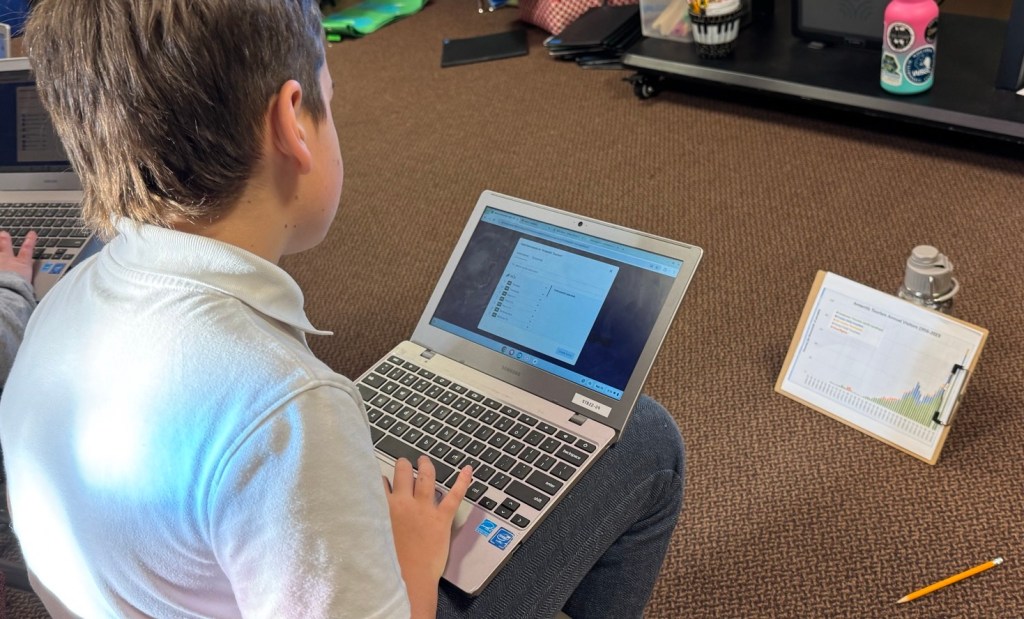
Next, students were tasked with creating their own music from data and graphs. The 7th and 8th graders have data they are analyzing from their science class project, so I had them take that data and compose music to represent what the graphs are trying to show. 5th and 6th graders were allowed to Google search something that they were interested in that would be displayed in graphs and charts. I had a collection of interesting graphs and charts for students in grades 3 and 4 to create their music with. Grades 1 and 2 had to find something they were interested in as a class, and then I guided them into making the music as students came up one at a time to select which notes should come next.

4th grader composing off of his data

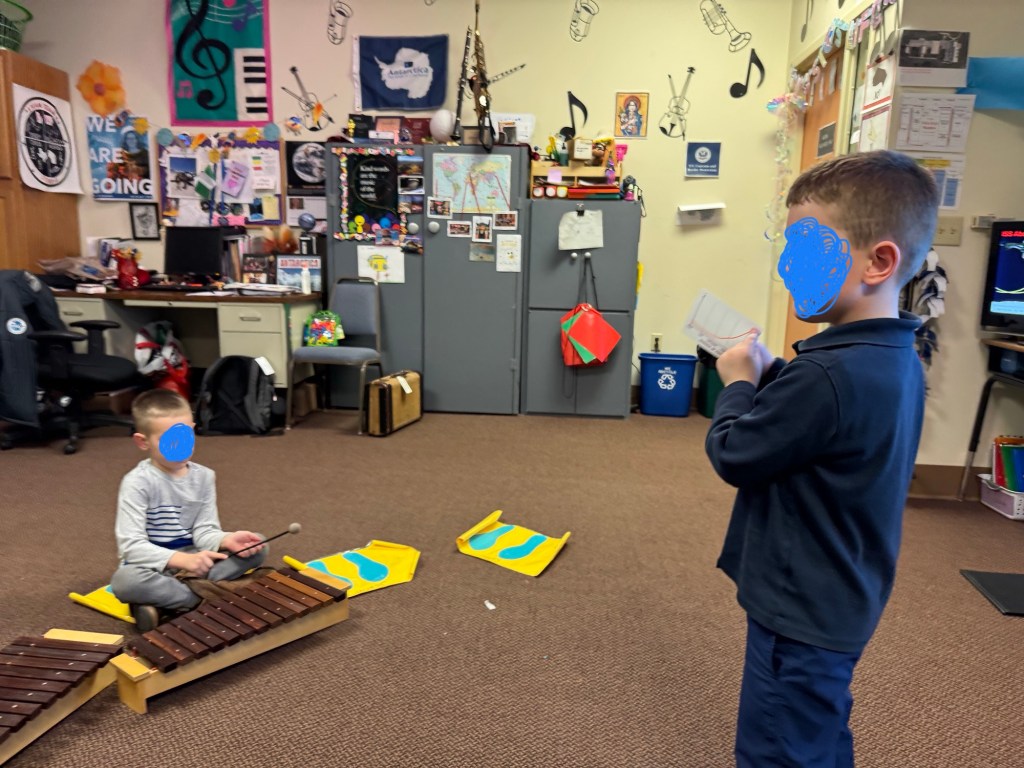
For the youngest kindergarten and preschool students, we used the science teacher’s game called “Charty Party.” I had one student come up in front of the class and be the “Scientist and Conductor,” and the rest of the class were musicians playing Orff instruments and Boomwhackers. The student playing the role of scientist and conductor had to look at the charts from the game, and then have musicians play their instruments in the shape of the graph. This was really fun to be able to show students how to read a graph, and to practice high and low sounds on our music instruments. Each student got a chance to be a Scientist/Conductor, and play each instrument!

Kindergarten students – one Scientist/Conductor, and a class full of musicians

Antarctic Treaty Musical Quilt

Today in music, we learned about the Antarctic Treaty. We explored the countries that have signed it and what the laws of the treaty entail. We then compared that to the Artemis Accords, which are a similar agreement to sharing resources and research in space. We compared which countries have signed both (and, even more interestingly, which countries have not along with the implications of why countries may not sign).

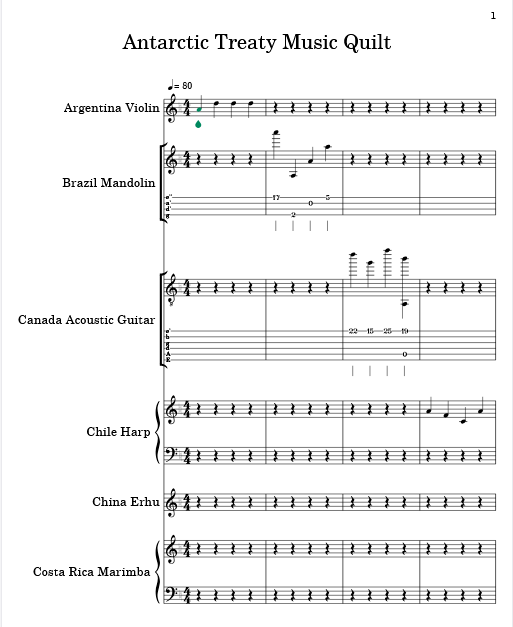
Students then had to pick a country from the Antarctic Treaty. They researched instruments that are traditionally used in the country’s music, and composed one measure to represent their country, based off of rhythms they hear in the country’s national anthem (thus testing their aural skills – requiring them to transcribe a rhythm from the national anthem).

Each country’s anthem was linked for students to explore

After each student was done, I compiled each student’s measure and added them together into one giant composition, much like different quilt squares come together to create a beautiful quilt. This piece of music represents the countries of the Antarctic Treaty!

Every country had its own instrument and measure in this musical quilt
Here’s the students’ work!