
I think the fun thing about traveling anywhere is seeing what the traffic and driving patterns are in any new spot. Every place that I have been has had its own unique driving style, and I am always happy to use public transportation or let others drive in new places because of this.
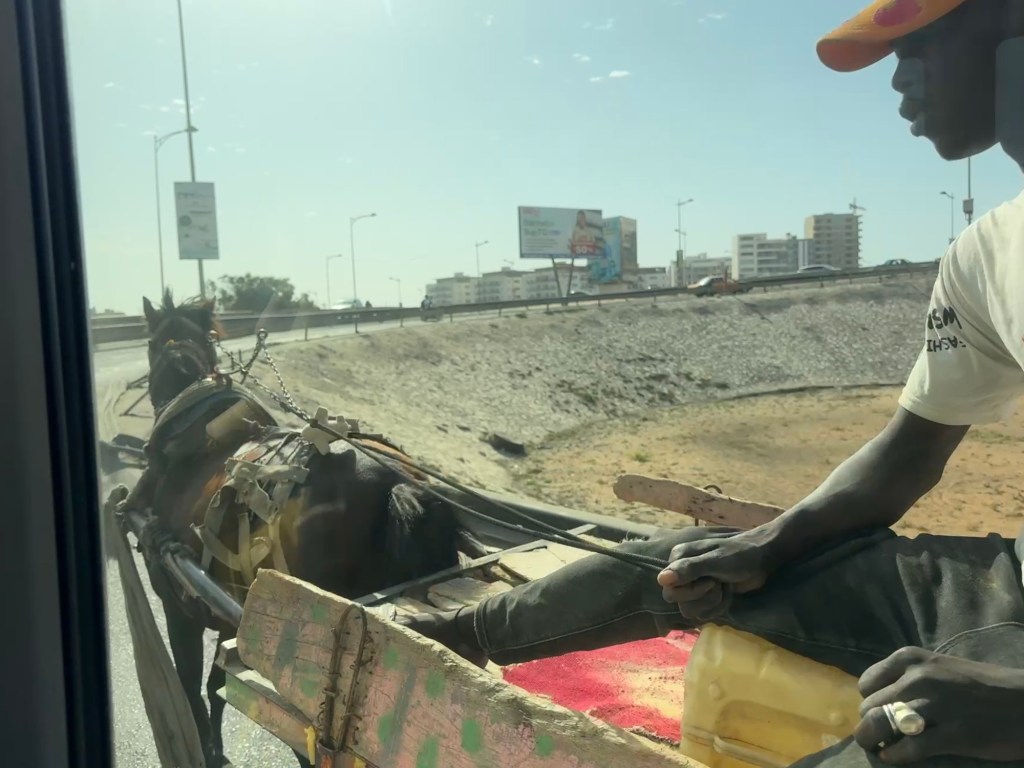
Senegal did not disappoint in this area, either. We were on our way to the city from the airport on our very first morning in Senegal. As we were driving what would normally be considered a busy interstate in the US, I noticed there were carts being pulled by horses (called ‘charrettes’) on the same fast-moving, multi-lane highway. I found this amusing, but also grew to love the contrasts between that mode of transportation and the zippy motorcycles and mopeds weaving between cars and semis on the highway!

Additionally, I observed the most interesting rules of the road in Senegal. Consider this my “Guide to Driving in Senegal.”
First, the lines between lanes on the highways are often non-existent. The locals don’t have any trouble with this, but for me this took a little getting used to. However, that said, when there were lines, it appeared they were optional to follow, as well. Often cars and other motorized vehicles would drive wherever they wanted to get around slower cars.

Roundabouts also appear to be an interesting event in Senegal – the cars were coming at us from all directions…..
Speaking of going around cars that are driving slower than you – as far as I can tell, the entire country is considered a ‘passing zone.’ The proper technique to let others know you’re passing them (and also to let oncoming traffic know that you are in their lane) is to flash your lights. This flashing of headlights would happen if you were following someone in the same lane as you who is driving faster (letting them know to get out of your way). The flashing of lights would be used to let oncoming traffic know you were in their lane and would be there as they continued towards you, so maybe they should slow down or go off the side of the road. The flashing of lights was also used to let someone who looked like they were going to pull out in front of you that the idea of such a thing was unwise. If things looked particularly dicey, the horn came into play to let those drivers know not to cut you off as well. Lights communicated a lot!
I bet you are wondering with all of this passing, and the light-flashing at intersections, how does one decide who has the right of way? I will tell you – it is the person who is unwilling to yield to anyone else. After much observation, I can tell you that the right of way is given to the person who has less to lose! Sometimes this becomes open for a loud debate….
In fact, if you are merging into a tollbooth, or onto a highway in a congested traffic area, the best thing to do is to roll down your window and discuss it with the driver of the vehicle that you are hoping will let you in. This ‘discussion’ is best done while still nudging your car into the real or perceived gap you are trying to fit into. Sometimes it may not be possible to slide more than a few sheets of paper between each car!
How do the Senegalese find their way to locations? While in the US, everyone has their favorite navigation app – be it Google Maps, Apple Maps, Waze, or any other fun variation on that familiar theme, the Senegalese use something different: other people. The Senegalese in general are usually outside – walking, eating, shopping at market stalls, talking with others – they are a very social group of people. There is ALWAYS someone nearby. Whenever we went somewhere, my host teacher would always end up rolling down her window, greeting people in Wolof, and asking for directions. Most times the people would know where she wanted to go, but other times they would point her to the next intersection where we would roll down our window and repeat the greeting and question. Sometimes it would take us only one stop to find our location, and other times it would take us over 7! Who needs GPS?!?

Now one thing that is very interesting is how often our driver got pulled over. We rode with the same driver for the 9 days we were in Diamniadio. During that time, he got pulled over 7 times. The police set up at a spot on a road, and then stand outside their vehicles. If they point at you, you must pull over and wait to find out what you got pulled over for. Often, these stops took some time, as the police were hoping you would just pay them some money to continue on your way in a timely manner. One time, our driver was pulled over and they told him his license was being taken because he was wearing sandals to drive. Do you know how they knew from the road that he was wearing sandals? They didn’t. They couldn’t find anything else wrong with what he was doing, so they cited him for that. The next morning, he drove to the City Hall, paid his fine, and got his license back. The funny part? He did all of this in the same sandals he was wearing the day before. The other things he got pulled over for was the tint on the windows and our host teacher not wearing her seat belt. We didn’t hear the other reasons why he had to pay fines.

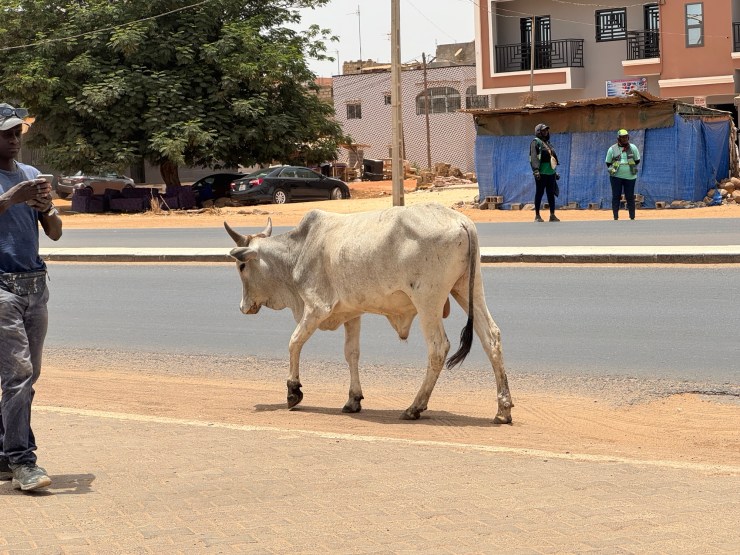
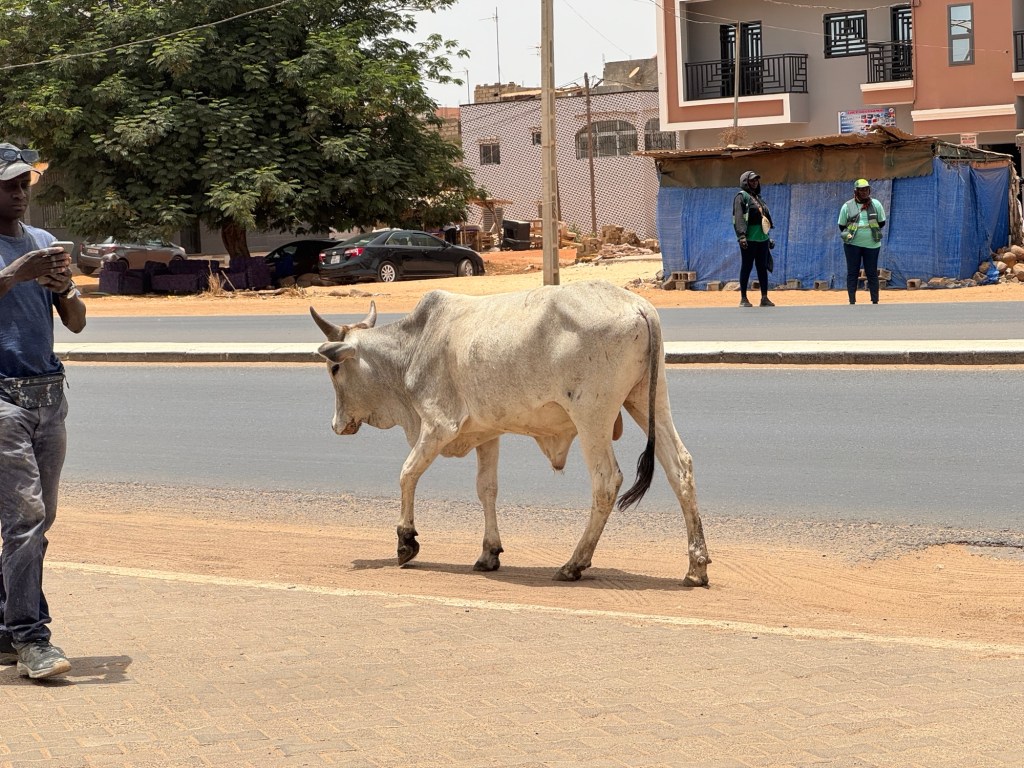
Other fun things to watch out for? There are cows everywhere! I’m pretty sure that due to their size, they get the right of way…
Also, don’t be scared of the people hanging off of the back of vehicles. People use these vans as public transportation, and there isn’t a capacity. People will sit practically on top of each other, stand, and hang off of the back to get to where they need to go.

Let’s say you are driving in Senegal, and the concrete road ends. What do you do? Keep driving, of course. The major roads are paved, but driving around through the towns are all done on dirt roads.

Now, you might be thinking “Why would I want to drive with all of this hassle?” Well, you might want to know that I am pretty sure Senegal may have been doing “curbside pickup” for much longer than we have been doing it in the US. For us, it mostly started during COVID, but I can imagine the Senegalese pulling up to the roadside market stalls and purchasing the freshest fruit from their favorite vendor decades before 2010! What better way to pick out your produce than from the comfort of your own passenger seat?

So, now that you know how to drive in Senegal, are you ready to give it a go? If not, I can assure you the taxis and the train are great options! Just make sure you negotiate the price of each taxi ride BEFORE you get in the car!

 Car Full of Harmony
Hi Lisa, could you share who your driver was and what you approx paid for a day? we’re travelling to Senegal coming March.
LikeLike
Our driver was arranged through our host teacher, so I have no info on how to arrange to use him – he was someone my host teacher knew. I also know that it wasn’t as expensive as I would have thought, but I do not remember how much it costs. Maybe a few hundred US dollars for over a week of driving us all over Dakar, Pink Lake, the beaches, and Diamniadio. If you can get a driver, it will make your life much easier, as every taxi ride involves negotiations!
LikeLike