
While I was out of town for my Fulbright Global Symposium, the students got to take the data they had collected on the weather in Wisconsin and combine it with the observations I had made while in Antarctica.
This idea came from the craft concept of Temperature blankets, where people will crochet or knit a row onto a blanket representing the high temperature of the day for a full year. By the end of the year, they have a 365-row blanket that depicts the temperatures in their location throughout that entire year. They are very unique, and often quite beautiful!
I created a chart for students to be able to compare their temperatures to in order to assign the correct notes and rhythms for the weather they had. They were also required to pick out an instrument that represents our state, school, or the student personally.
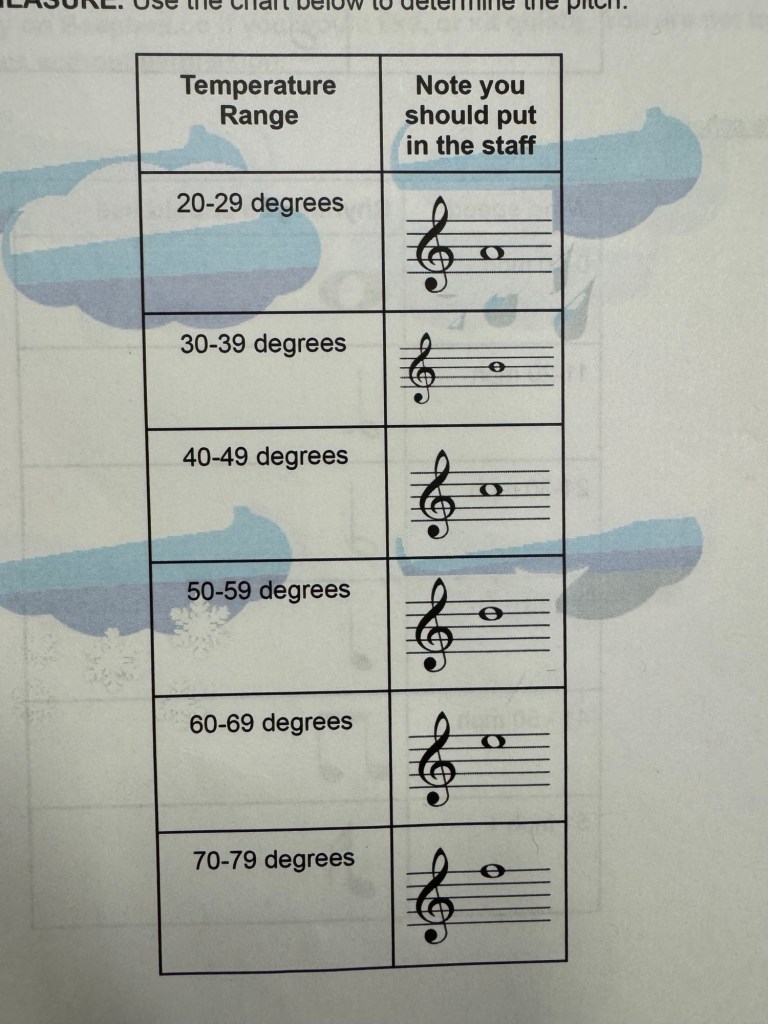

I then shared my data with them and they had to plot this onto a duet part to accompany their weather melody. They had to pick out an instrument that represented Antarctica.
When I talked to the students about how the lesson went, they were surprised by the number of times that they were cooler in Wisconsin than I was in Antarctica. They also were impressed by the wind speeds I experienced.
The weather musical composition wasn’t always pretty sounding, either, as we were often similar enough in temperature that musical dissonance occurred. We talked about why that dissonance happened, and now they realized that dissonance can be a useful compositional technique, as we explored why a composer would choose to put dissonance into his/her compositions.

 Car Full of Harmony
Published by