
March featured a real breakthrough for me in my Embedded Teacher project. Throughout this experience, I really wanted to make an impact with my experiments – I wanted to contribute in some way to the world of science. However, I found out that is really, really hard to do, particularly where I do not feel like I speak fluent science! Combine that with the fact that each zero gravity experience will be 22 seconds long, and it can really seem impossible!
While I was working on fine tuning my experiments for the last push before Dr. Crosby sends them off, I was starting to get bothered by something. I felt like in my big efforts to make sure that there was something for every grade level in my school in my proposal, it appeared that I didn’t have anything that truly had meaning for the band students I work with on a regular basis. The whole reason I did this opportunity was for the students I work with regularly as a BAND DIRECTOR. I got to thinking about what I can do for them – how to get back to MUSIC, and not just thinking about sound. I thought about the music standards for education, and I thought about what my students need and love about band. But how could anything musical be dependent on gravity???
Through all of this thinking, I started to remember something way back in the depths of my brain – something about Mozart creating compositions using dice. That then got me thinking about how a die in a container would pop up in 0 gravity, and fall down again when we hit the gravity part of the parabola. Would the die roll, though, or would it just keep landing on the same number? I’m hoping that due to the same engine inconsistencies that prevented me from being able to vibrate a water bubble with a tuning fork would cause the die to roll on this flight. I wrote up this idea, and buried it in the back of my proposal, as I wasn’t sure it would get much enthusiasm from my science friends. However, I figured it was a passive experiment, as I just needed a camera pointed at the die for the whole flight, so maybe they would let me just run it in the background. It was worth a shot…
At our March 2 meeting with Dr. Crosby & crew, I pitched my composition experiment idea, and the National Space Society women and Dr. Crosby LOVED it. They were so enthusiastic and supportive of the idea, and pointed out that this was the reason they included steAm teachers instead of making the experience only for STEM teachers. I was so excited because I felt like I had finally earned my spot. Even more excitedly, my students will get to see how MUSIC truly does connect with everything.
The next day, I created a video intro to the mission patch contest we were hosting at my school. I talked about what mission patches were, showed some examples, and gave the students some requirements if they wanted to be eligible for the contest. Every student in the school would be participating, all the way down to the 3K kiddos. I didn’t expect them to meet all of my requirements, but I did want them to create some artwork I could fly with. My requirements for the competition were: 1) the design had to have an element of music in it – after all, that was what my mission was all about. 2) The design had to incorporate a religious symbol, because I wanted to represent our school. 3) The design had to have a space item in it somewhere, to represent the reason microgravity is even studied. And, finally, 4) the design had to have our mission name (SOSITA) on it somewhere. Students would get bonus points if they could sneak something to represent a unicorn in their design, but it was not required. Students would be working on this in their art classes, so that made it even more exciting! If you want to watch the video, it can be found here: https://youtu.be/ELVDTSuvq7M
On March 7, at my weekly school meeting, one of our creative teachers in the building thought it would be neat if I took over the big bulletin board in our school hallway to showcase my flight information. This bulletin board will be in a prominent location for the visitors who will be coming into our school for our annual fundraiser. This event will be at the end of April, and brings many people into our school. My principal also shared information from her friend who used to work at one of the local news stations about the best ways to get our press release some traction.
At our weekly Embedded Teacher meeting, Dr. Crosby told us to watch for emails from him over the weekend as he finalizes the PIP (Payload Integration Package) for each of our experiments. We’re in the home stretch on all of the upfront work, so that’s good news. I also went into the 3K class at my school. The teacher had suggested a moon puzzle to do with the kids, as they are having their 2-week long space unit. I had so much fun with them, and they were such good listeners. We talked about how the moon is really a great big mirror that shines the sun’s light at us at night. We also put together a phases of the moon puzzle, and I taught them how to say the names of the phases. There is nothing cuter than 3K kids saying “waxing gibbous.”
Towards the end of March, things really started rolling quickly – on March 14, we solidified the voting process for the Mission Patch design challenge, and found out that Nicole Koglin from CBS 58 is interested in covering our story on the news, thanks to a facebook message I sent her. On March 16, Dr. Crosby let us all know that “the heavy lifting is done,” and all of our proposals have been sent off to the Zero-G corporation for approval. Now we wait patiently…On the same day, I went into the 8th grade science classroom and taught the 8th graders my sound experiments for the flight. They are starting their sound unit, so I am going to have them teach the experiments to the younger students in the school. This will hopefully really solidify their understanding of the basics of sound waves. They were so responsive and excited to learn about these experiments. I even heard a few kids talk about how much fun they had as they left the classroom that afternoon!
On March 21, we discussed the spring concert plans and upcoming timelines for our deliverables. The spring concert is going to serve as the culmination point for this project – the students will be able to demonstrate the experiments for their parents, along with performing music that will follow our “Reach for the Stars” theme. We will display artwork and observations from the experiments the students did so the parents and community can see what we’ve done all year. I’m very excited for the students to be able to look back on the whole journey and see the big picture!
On March 23, the 8th graders had their Demo Day – showing the younger kids in the building the experiments. It was so fun to listen to the 8th graders teaching the youngest students about gravity and sound. I loved listening to them as the experts, and the younger kids idolized the older kids. It was really the coolest part of this project so far. So much fun! That night, we had our Embedded Teacher meeting, and we learned about how our lesson plans, artifacts, and story of our journey should be uploaded into a file created for us. Then the National Space Society will have people who will turn these pieces of evidence into lesson plans and webpages for us so that others can use our work and see our experiments. It is pretty cool to think that my project will have a national (or even international) audience! We also got to fill out our flyer forms – listing our weight, medical information, etc. for the spring flight! It’s getting a little more real each day!
During this week, we were also wrapping up our mission patch design project. We had a team of 5 teachers narrow down the school’s submissions to the top 10 designs on Tuesday of that week. On Wednesday, 2 teachers, Mary, and I selected the top 3 from those 10. The top three featured a patched from a 3rd grader, a 7th grader, and an 8th grader! I was so excited for any of those top 3 to win – they were fantastic! Then, I created a Google form for every student to vote for their favorite from the top 3. Voting took place at the end of the week. It was exciting to watch as each vote came in on the Google Form. I’m pretty sure I was watching it all day, trying to figure out which of the 3 patches would win!
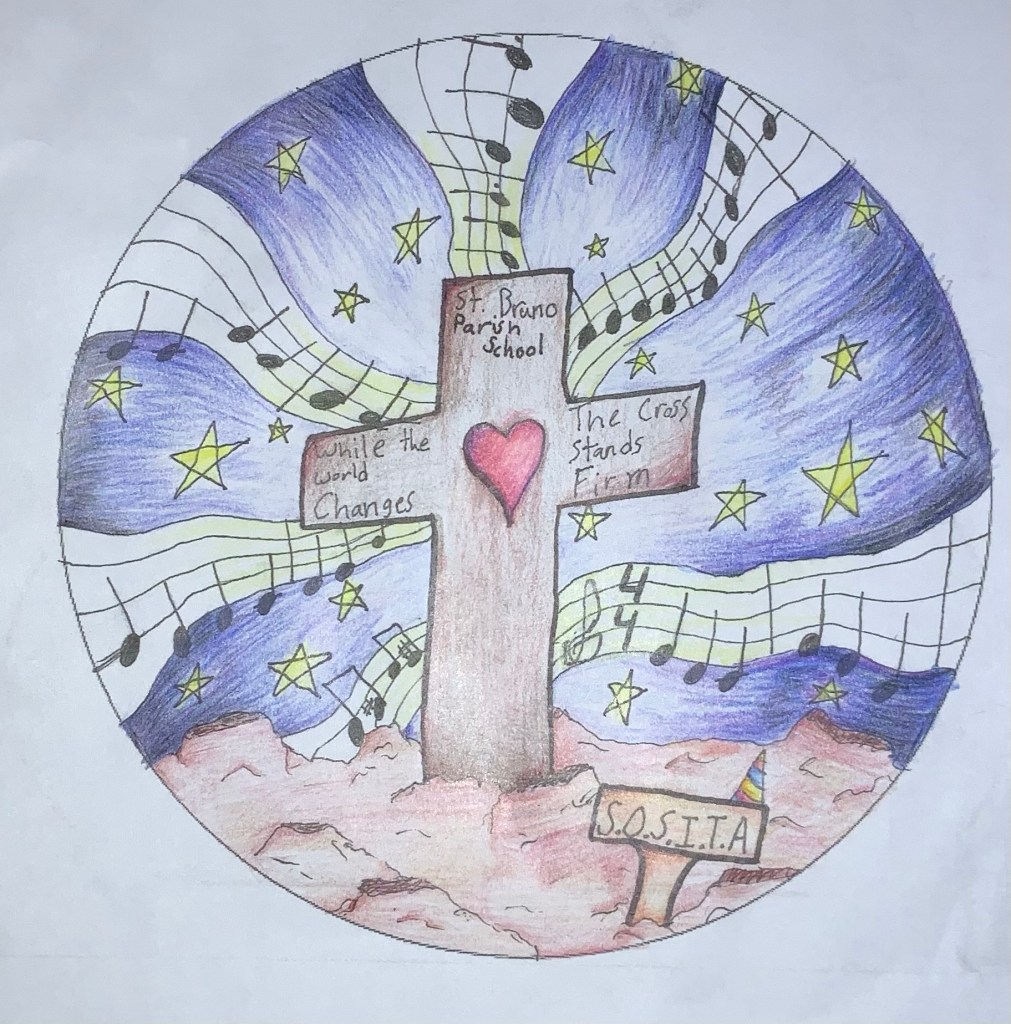
On Monday, March 28, I got to announce the winning patch design! It was so much fun to hear the kids in the hallways talking about who they thought was going to win, and who they voted for. I got to announce the winner over the loud speaker, and I asked the students to do a drumroll on their desks before I announced the winner. I could hear the desk drum roll from the whole school IN THE OFFICE! It was awesome! For our school meeting that day, we talked about the pre-flight assembly we are planning, and what will happen with the winning patch (we are contacting companies to make the patch and give us quotes on pricing). I also shared news that Brian Kramp, from Fox6 news, was going to pitch our news story idea to his producers in hopes of covering our story.
On March 30, we had our last Embedded Teacher meeting of the month. We discussed our ground testing videos that need to be submitted for any questions that will pop up about our proposals. I did mine awhile ago, so I asked if I needed to do them with me and the actual flight instruments, as well. Dr. Crosby suggested thinking like a ‘very nervous TSA safety engineer,’ so I will make lots of extra videos just to be sure!
And just like that, another month of Embedded Teacher adventures is over. From here on out, I will be posting updates in real time, instead of this slightly long rundown of a whole month’s fun. Stay tuned, as I am five and a half weeks away from flight! WOOHOO!!!!!!!

 Car Full of Harmony
Published by