
Expecting a response on my proposal was not on my radar for a few months yet (if at all). I was gearing up for the Space Exploration Educators conference in Houston in the beginning of February. I was working through all of the cool space & music lesson plans I had made for my proposals for the Embedded Teacher program. I was getting ready to end the 1st semester of this school year. It was January 12, a month after I had submitted my second proposal, when I got a surprising email in my inbox.
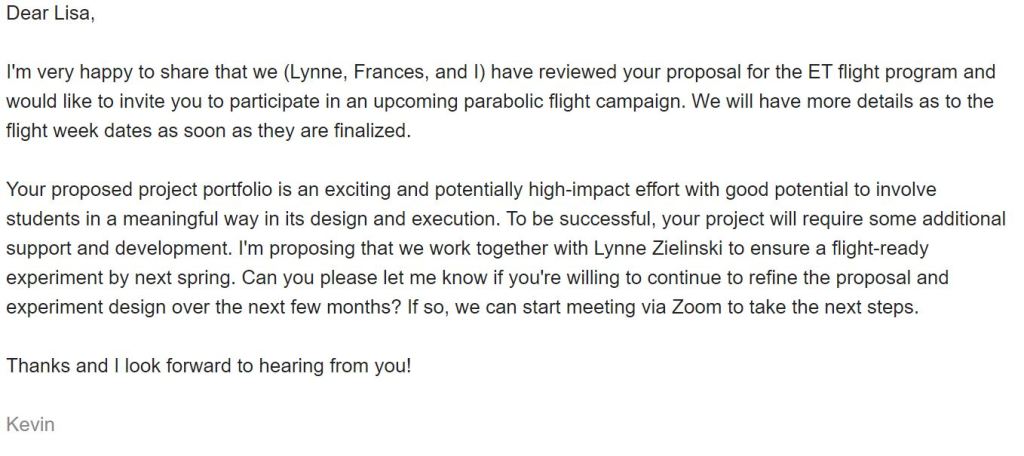
And that was how the next phase of my journey began!
From January 30 on, we have met every Wednesday afternoon at 4:30 pm via Zoom to discuss the aspects of the flight. I am in these calls with 3 other teachers who will be flying – amazing women from Iowa, Georgia, and Texas. After I came back from SEEC, I also would have a weekly meeting at my school with Mary MacDonald (the fantastic principal at St. Bruno) and Tammy Price (whose title is administrative assistant, but she does so much more than that!). The rest of this blog is going to serve as a summary of those experiences to document my journey, and once I’m all caught up, I’ll begin having entries to update this adventure in real-time.
So, as I mentioned, my first official meeting was on January 30. I learned that I might be flying in the spring, or if I needed more time to get my package together, it might be the fall. I was a little bummed about the idea of waiting until fall after getting all of my current students so fired up about space (which is our theme for the year in my class). Then I was introduced to a Trello board that has been set up for all of the teachers who are flying, so that we can see what needs to be done and communicate easily back and forth throughout the process. Overall, the first meeting was a bit intimidating and overwhelming as I saw all that had to be done before I could be set to fly experiments.
The following week was SEEC, so we were all in Houston together. We met up for breakfast to speak in person. I am so glad we did! It was really nice to hear how overwhelmed and nervous the other teachers were as well. I felt better knowing that the science teachers weren’t sure that they were good enough or smart enough to pull this off. If they were all feeling the same as I was, I must be doing ok! Dr. Crosby was great at calming us down – he said that the whole process is a success if it creates a meaningful experience for our students. That was the whole point of this adventure, and as long as we used that as our guide, we wouldn’t be letting anyone down.
February 7 (the day after I came back from SEEC), I started meetings with Mary and Tammy at school. I first need to say how amazingly supportive my principal and colleagues are, even without this Embedded Teacher experience. I am so lucky to teach at a school where I can teach band in an out-of-the-box way to get my students enthusiastic about making music and connecting to subject matters they love outside of music. I think back on the teachers who made the biggest impression on me and motivated me to work hard, and they weren’t always my music teachers. My chemistry, physics, French, and English teachers in high school were the teachers I look back on from those years because they found a way to connect their subject matter to what interested me. They showed me that what I enjoyed learning about also had applications with their concepts and ideas. Throughout this entire adventure, I have been reminded of how much they taught me about music without being music teachers. And now, I am returning the favor by teaching my students about space while being a band teacher.
So, back to my meeting with Tammy and Mary – we started calling our meetings “Project Sparkle Unicorn,” as I was the unicorn in the room by being the music teacher amongst all of these awesome STEM teachers. When I told my friend about this, she said “no, you are the SPARKLY unicorn,” and I’ve just started to embrace that to bolster my courage in this whole process. In my meeting with Mary and Tammy, we discussed my school integration plans (as I want this to be a whole school experience, rather than something only my band students will benefit from), and we developed some timelines for these plans, along with media plans.
On February 9, Dr. Crosby gave us our timelines for the requirements of all paperwork and submissions for our proposals. It still looks very scary and intimidating, but a little bit more doable. I remember thinking that I better stay on top of these dates, and how nice it was to have them so I could stay focused on one step at a time. I also had a funny epiphany in this meeting. The wonderful teacher from Georgia was talking about some cool sound experiments using a tuning fork. I had ruled out a tuning fork in my experiments, as I knew it wouldn’t be heard on a flight with engine noise and the other noises from other experiments. As she was describing this idea, I realized that I was definitely biased by my musical training – see, for me a tuning fork produces sound for us to hear. In the science world, a tuning fork produces VIBRATION. You don’t need to hear a tuning fork to know that it is creating noise. Weird revelation for me, for sure! Anyway, then I got this crazy fun idea of trying to squeeze out a water bubble (in a glove box, because those are the rules for flight) and vibrating it with a tuning fork. I was giddy beyond belief at this idea, as one of the most fun sound experiments to do in classrooms is to hit a tuning fork and then place the vibrating end into a cup of water – instant splash!
February 14th’s meeting at St. Bruno was mainly focused on creating press releases for our local newspapers. On this day, I also visited the 6/7 and 8th grade ELA classes to present my flight info. After this, we discussed how NASA names its missions, and then introduced a mission naming contest for the middle school students to participate in. To enter, the students needed to come up with a mission name and write a paragraph describing what their mission name’s connection to my flight would be. We discussed how NASA mission are often named after Greek and Roman gods, and since we are a Catholic school, we could pull from our beliefs to connect to my mission. We also talked about NASA’s love for acronyms, and how the mission name could be an acronym instead. It was fun answering the students’ many questions about the flight and how it will all work. I think I have a few volunteers if I am unable to make it for some unknown reason! I learned that when I am excited, I really don’t remember to slow down my speaking speed. Luckily the students all listen fast, but I have to get better at that!
I pitched my tuning fork/water bubble idea in our weekly Embedded Teacher zoom meeting on February 17, but Dr. Crosby told me that it won’t work. The airplane’s engines are changing too quickly that the water bubble would be too unstable. Oh, well…it was a fun idea, but I’ve still got plenty going on without adding that experiment.
On February 21, in our school meeting, we discussed the plans for the students designing a mission patch. Every NASA mission has a mission patch that is worn on the astronaut’s flight suit. I thought it would be fun for every student to design a mission patch, and then I will fly their designs with me when I go for my flight. Mary & Tammy have worked the school budget in a magical way to squeeze out some money to take the winning student’s design and have it made as an embroidered patch for every student and teacher in the school. I will also get one to wear on my flight suit. We also continued to discuss our media outreach plans, aiming for television stations this time.
My February 24 meeting with the Embedded Teacher group was particularly fun, as I was playing in a rehearsal for tech week of the production of “Anastasia” at the high school I teach jazz band at. One of the awesome directors loaned me her laptop to use for the zoom meeting, as it was much easier than trying to get any of my devices on the school wi-if. At this meeting, we discussed submitting our final experiment proposals for the Zero-g Corporation (the company responsible for the flight). We needed to have measurements of the dimensions and weight of every item we are bringing along, and attached Material Safety Data Sheets (MSDS) for the items, as well. Mine were done, and waiting for any questions Dr. Crosby would have, as he fills out the formal Payload Integration Packages (PIP).

On Sunday, February 27, Dr. Crosby added comments to my Google doc that housed my final proposal. It was a little overwhelming, as the amount of details needed are very involved. Dr. Crosby did an awesome job of explaining why Zero-G needed to know the exact amount of cupcake sprinkles I was going to use, and the other things I needed to elaborate on. I thought this was particularly awesome of him, since you should have seen how many comments I had to resolve on my document! It was very overwhelming, but his explanations taught me a lot about what the flight will be like and why all of the tiniest of details are important. Definitely a learning experience, for sure!
February 28 was a big day! Our mission naming contest ended, and some of my favorite names were: S.O.S.I.T.A. (An acronym for Sounds Of Space In The Air), Flight of Enob Mort, and Mission Band In….Space.
I had the middle school teachers help judge the contest, and the winner was SOSITA! In my meeting with Mary & Tammy, we discussed getting our mission patch contest going (which I’ll talk more about in the next blog…sorry for the teaser). I also went into the 8th grade science classroom, as those students are helping me design how I will attach a sound tube to my bell. Our awesome science teacher helped me use proper science terms (like criteria and constraints! I felt fancy!), and had supplies for the students to create with after I showed them what this harness needed to be able to do. After that, I also got to visit the 1st graders in our building, as they are doing a unit on sound. Our first grade teacher is so much fun – she invited me in to have a little noisy adventure with her students! I showed the students how sound can make cake sprinkles move due to vibration (totally spoiling my future flight experiment demos for them…hahaha), and I showed them how you can see and feel vibrations in instruments (like when you hit a cymbal). I also showed them bigger instruments are lower and smaller instruments are higher by using the Joia tubes I had won a grant to purchase last fall. They were so much fun, and I loved the look on their faces when they saw the sprinkles move! Totally priceless.
And that’s the rundown on January & February…it really was a whirlwind, and there’s still so much more to do!

 Car Full of Harmony
Published by